Crude Oil
June 18, 2026
OPEC hikes 2050 oil demand forecast again, citing world’s pivot to energy security

Editor:
HIGHLIGHTS
‘No peak in oil demand on the horizon,’ OPEC says
Global oil demand to reach 124.1 mil b/d by 2050
Industry must invest $17.7 trillion to meet demand
OPEC has raised its long-term oil demand forecast for the third consecutive year, now expecting global consumption to rise 19 million barrels/day -- or 18% -- by 2050, as governments increasingly prioritize energy security, rather than aggressively transitioning away from hydrocarbons.
Oil will retain the largest share of the energy mix, with demand reaching 124.1 million b/d by 2050, up from 105.1 million b/d in 2025, OPEC said in its World Oil Outlook released June 18. It is an upward revision from its forecast of 122.9 million b/d in OPEC's 2025 report, which was released in July last year.
Since then, energy security concerns have been further fueled by the war in the Middle East, which has led to a significant reduction in output and exports from the region.
OPEC Secretary General Haitham al-Ghais said that many governments are reevaluating energy policy, with concerns about the compatibility of net-zero targets with energy security.
"Indeed, there is an increasing realization of the need to balance the elements of energy security, emissions reductions and sustainable development," he said in a foreword to the outlook.
This contrasts with IEA forecasts. Under its "stated policies scenario," the IEA expects oil demand to plateau at around 102 million b/d around 2030, before gradually declining, it said in its World Energy Outlook released Nov. 12.
OPEC said that recent policy changes in the US, the EU and many other parts of the world are supporting oil demand in these regions.
"In many cases, these shifts reflect the reversal, delay or cancellation of previously ambitious targets and commitments aimed at reducing oil demand, through substitution or improved efficiency across various sectors in the medium and long term," OPEC said in the outlook.
In the shorter term, OPEC estimates that oil demand will grow from 105.1 million b/d in 2025 to 113.3 million b/d in 2030 due to these policy shifts and economic growth outside the OECD.
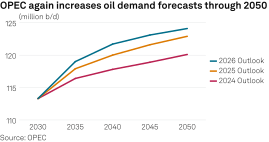
OPEC sees road transportation, petrochemicals and aviation accounting for the largest demand increases.
It expects Chinese oil demand to grow from 16.9 million b/d in 2025 to nearly 19 million b/d in 2035, before gradually declining to 18 million b/d in 2050.
Investment challenges
OPEC said the oil industry requires $17.7 trillion in investment from 2026 to 2050.
Oil producers' investment plans have been complicated by extreme volatility in the global markets, as well as uncertainty over the impact of conflicts in key production regions and the imposition of tariffs.
Platts, part of S&P Global Energy, assessed Dated Brent at $80.345/b on June 17. Conflict in the Middle East has driven price swings in 2026. Dated Brent has ranged from $77.81/b to $144.42/b since the US and Israel attacked Iran on Feb. 28.
The conflict has also led to a sharp decline in OPEC production, but the group expects a significant increase in its role in global liquids supply in the long term.
It maintained its estimate that OPEC+ supply will grow from 48% of the market in 2025 to 52% in 2050. It expects the group's output to grow from 50.6 million b/d in 2025 to 55.3 million b/d in 2030 and 64.5 million b/d by 2050.
OPEC+ production no longer includes the UAE after it left OPEC and OPEC+ in May.
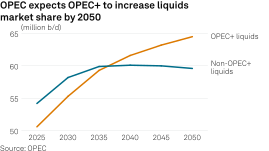
One of the most significant challenges facing OPEC and its OPEC+ allies is the rise of production outside the group. OPEC said this supply is set to increase from 54.2 million b/d in 2025 to 58.2 million b/d in 2030, primarily driven by Brazil, Qatar, the US, Argentina and Canada.
OPEC expects non-OPEC+ output to average 59.6 million b/d by 2050, an increase of about 5.5 million b/d from 2025.
OPEC said it has reassessed its outlook for US tight crude, and now estimates that this supply peaked in 2025, at just over 9 million b/d.
It sees total US liquids supply growing by 400,000 b/d until 2030 before plateauing, supported by a continued expansion in NGL supply and a small projected increase in biofuels.
