Crude Oil
June 12, 2026
Venezuela’s oil-linked debt with China could complicate its restructuring push
Editor:
HIGHLIGHTS
Venezuela owes China $10 billion -$15 billion
Chinese debt is repaid through oil shipments
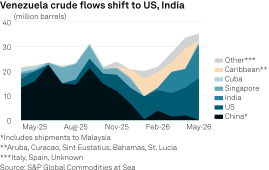
Exports to China dropped to zero after US intervention
Venezuela's plan to restructure its sovereign and oil company debt could boost oil investor confidence, but the country's debt to China could be a hurdle to the final resolution of the matter, experts say.
The exact amount Caracas owes Beijing is unclear, but estimates range from $10 billion to $15 billion, compared with Venezuela's estimated external debt burden of $150 billion to $200 billion.
The debt to China may become a hurdle to restructuring, not because of its size but because of its structure, Philip Luck, the director of the economics program at the Center for Strategic and International Studies, told S&P Global Energy.
"The loans get repaid on oil that flows through an account Beijing controls, which puts it ahead of the bondholders in any restructuring," Luck said. "Any IMF plan where debt holders have to take a haircut, and China refuses, given its position, is going to be a problem."
The amount of debt Venezuela has with China, Iran and Russia is unknown, Gustavo García, the coordinator of opposition leader María Corina Machado's economic team, said during a June 4 event held by the Pacific Council.
If Venezuela restructures part of its debt without auditing and conducting a sustainability analysis of the entire debt, as some are proposing, the outcome may not be sustainable, García said.
"We run the risk of, after we know the whole amount of debt and the payment conditions and so on, that the restructured debt is not sustainable because it was done without any sustainability analysis, as it should be done, with the International Monetary Fund," García said.
If this occurs, the debt may have to be restructured again, which happened with Greece, Argentina and Ecuador, García said. "I am not sure if the debt holders are willing to take that risk," he said. "This is for me, personally, a serious concern."
China on hold
It is unlikely China is getting much of its debt repaid through oil sales right now because only oil that goes to China pays down debt, and crude exports from Venezuela to China have dropped since the US intervened in Venezuela, Luck said.
Venezuelan crude exports to the US rose to 17.1 million barrels in May, and Indian receipts climbed to 13.5 million barrels, as refiners stepped up purchases of heavy crude, S&P Global Commodities at Sea data shows. In contrast, shipments to China remained absent in May for a fifth straight month.
Venezuelan debt to China may be part of debt restructuring, but the US government is unlikely to prioritize settling the debts of Chinese entities, said Rachel Ziemba, a senior adviser with Horizon Engage. "Chinese debts could be a distraction from other attempts to settle the debt," she said.
Current US licenses ensure that funds from the sale of Venezuelan oil are not sent to China, Ziemba said. US licenses also do not allow sanctions exemptions for Chinese joint ventures, likely limiting the ability of the joint ventures to produce and trade, she said.
US license 52, which authorized certain transactions with PDVSA, prohibited any transactions with an entity organized under the laws of Venezuela or the US that is owned or controlled, directly or indirectly, by or in joint venture with a person located in or organized under the laws of China. Other recent US licenses have included similar language regarding China.
"I anticipate we will see Chinese JV partners encouraged to reduce their role and to be replaced by other holders," Ziemba said.
China advanced billions to Venezuela between 2000 and 2018 via petro/financing arrangements, to be paid back via oil exports, John Haley, a partner with the law firm Nelson Mullins, said.
"Some barrels that formerly supported those arrangements are now being sold into other markets, but it remains unclear to what extent the resulting proceeds continue to flow toward servicing Chinese claims," Haley said.
The US Treasury Department did not respond to a request for comment regarding repayment of Venezuela's debt to China.
Chinese joint ventures are operating with the fewest personnel and the lowest possible expenses, according to a source at a Chinese state-owned oil company with investments in Venezuela.
Venezuelan debt payments to China cannot be made anymore since Chinese JVs were suspended after the US intervention, according to a source with a Chinese state-owned financial company.
"The Chinese government neither supports nor encourages those companies to maintain operations in Venezuela," said the source.
Chinese companies have numerous investments in Venezuela. CNPC's largest joint venture in Venezuela, Petrolera Sinovensa, has a crude blending plant as well as a block in the Orinoco Belt that produced 91,200 b/d in May, according to Venezuela's Ministry of Hydrocarbons.
China Concord Resources has two productive participation contracts with PDVSA, Lagunillas Lago, which produced 5,700 b/d in May, and Lago V, which produced 4,600 in May.
