Refined Products, Maritime & Shipping, Fertilizers, Chemicals, Energy Transition, LNG, Fuel Oil, Bunker Fuel, Renewables
June 12, 2026
INTERVIEW: Singapore’s MPA sees extended multi-fuel shift amid market fragmentation

By Mia Pei
Editor:
HIGHLIGHTS
Fragmented rules risk costly supply disruptions
Singapore scales commercially viable alternative fuels
Maritime resilience hinges on cooperation
Singapore expects the shipping industry to operate across multiple fuel pathways for an extended period as uneven regulation, infrastructure readiness, and fuel availability complicate the sector's energy transition, the Maritime and Port Authority of Singapore's chief executive Ang Wee Keong told Platts, part of S&P Global Energy, June 10.
The transition will require major bunker hubs to support new marine fuels while maintaining reliable port operations and conventional fuel supply, said Ang.
"While there is broad alignment on the direction of the global maritime sector's transition, the pace of adoption, infrastructure readiness, and regulatory approaches will likely remain uneven across markets for some time," he added. "It is likely that shipping will operate on multiple fuel pathways for an extended period."
The comments came as shipowners, charterers, and bunker suppliers at Posidonia 2026 highlighted a more complex operating environment shaped by fragmented decarbonization rules, energy security concerns, and shifting trade patterns amid geopolitical tensions.
"The industry is increasingly operating in a world where disruptions, geopolitical tensions, and supply chain shifts are becoming more the norm rather than the exception," noted Ang.
He highlighted that, over the next decade, maritime resilience will increasingly mean "the ability to adapt and continue creating value in a less predictable operating environment". That, for Singapore, also means supporting shipping's energy transition beyond conventional fuels "in a practical and commercially viable manner."
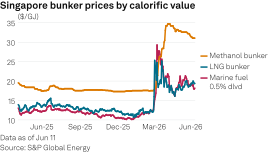
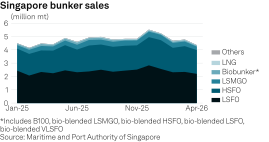
The world's largest bunkering hub has prepared for a multi-fuel marine market by scaling up LNG bunkering capabilities, issuing methanol bunker supplier licenses, and advancing ammonia bunkering readiness, said Ang.
Ports and marine fuel supply chains will need to support the transition "while maintaining operational reliability and efficiency," he said, noting OCEANS-X as part of efforts to facilitate trusted maritime data exchanges.
Fragmented environment
Ang warned that shipping could become more costly and less reliable if decarbonization standards, fuel infrastructure, and digital systems develop into incompatible regional regimes.
"Shipping cannot function efficiently if the industry fragments into separate regional systems with incompatible standards, infrastructure, or regulatory approaches," he said. "This would increase inefficiencies and costs across global trade networks, causing supply chains to be less reliable and more expensive."
The warning came as the industry discussed the alternative IMO Net-Zero Framework while disagreements between shipowners and regulators surfaced during Posidonia 2026.
Ang said major maritime hubs such as Singapore have "an important responsibility to continue supporting openness, interoperability and practical collaboration even amid broader geopolitical differences".
Singapore's approach includes supporting global frameworks through the IMO, working with industry on pilots and standards development, and implementing practical decarbonization pathways across multiple fuels, said Ang.
Nonetheless, he said collaboration needs to move beyond policy discussions into operational implementation, noting MPA's Green and Digital Shipping Corridors partnerships that help ports and other ecosystem partners develop solutions around digital standards, emissions accounting, fuel availability, and operational coordination across international trade routes.
On facilitating cooperation between jurisdictions, Ang highlighted MPA's partnership with the Port of Rotterdam to conduct trials on ship-to-shore data exchange, and Singapore-China digital exchange of ship certificates for Singapore-flagged vessels calling at Chinese ports.
"Singapore's role is to remain an open, rules-based and reliable hub that helps reduce friction and provides value for international shipping," said Ang, noting that maritime resilience will increasingly depend on how the industry can "continue coordinating effectively across complex and fragmented systems".
