Crude Oil, NGLs
June 10, 2026
Iranian crude drawdown cuts Asian floating storage despite sanctions, war risks
Editor:
HIGHLIGHTS
Southeast Asian floating stocks fall 20% in May
Far Eastern floating storage declines slightly
Iran floats more crude near home amid US blockade
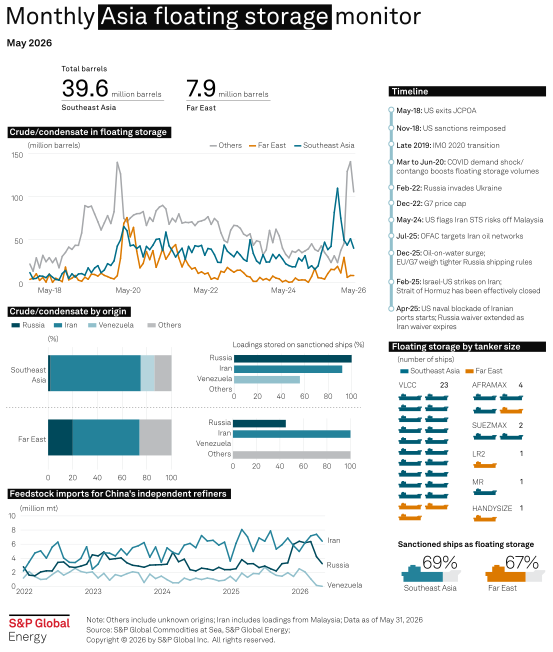
Floating storage of crude and condensate in both Southeast Asian and Far Eastern waters declined at the end of May, as Iranian barrels cleared into Asian markets while tightening US pressure on Tehran disrupted Iran-to-Asia flows.
Southeast Asian floating storage fell by more than 20% from April 30 levels to around 39.56 million barrels on May 31, driven by a 32% reduction in Iranian crude, according to S&P Global Commodities at Sea data. Far Eastern floating storage also declined, albeit more modestly, to 7.87 million barrels from 7.98 million barrels.
According to CAS, a ship is considered floating storage if it is laden and does not move more than 10 nautical miles per day for at least seven consecutive days. Russian and Iranian oil exports to China frequently involve ship-to-ship transfers in East Asian waters as the countries' logistics networks are targeted by Western sanctions.
Iranian crude floating in Southeast Asia stood at around 28.97 million barrels as of May 31, down from end-April's 42.5 million barrels. In the Far East, however, such cargoes built slightly to 4.22 million barrels, all held by sanctioned vessels listed by OFAC as of the end of May, from end-April's 4.13 million barrels.
The development came after the US began to impose a blockade on Iranian seaborne trades on April 13, prompting Iran to keep more crude floated at sea near its coast. CAS data shows the amount of Iranian crude in floating storage in the Persian Gulf jumped to 52.9 million barrels in end-May from 26.5 million barrels in end-April.
As of June 10, US forces have disabled eight ships and turned back 134 since the blockade took effect, according to the Central Command.
Chinese imports
China's independent refiners, despite cutting runs, continued to provide a critical outlet for Iranian crude during the month. The sector imported about 6.41 million mt of Iranian crude in May, following April's eight-month high at 7.39 million mt, according to data collected by Platts, part of S&P Global Energy.
The sector also imported an eight-month low of 3.21 million mt of Russian crude and did not import Venezuelan crude in May.
While Washington enforced its naval blockade targeting Iranian ports announced in April and tightened sanctions on Iranian crude exports, the sanction waiver on Russian crude had been renewed twice, allowing certain Russian crude cargoes already loaded on vessels to be sold and delivered through mid-June. No extension was granted for Iranian crude, as its waiver expired on April 19.
Shandong-based sources said the price for Russian ESPO with July delivery was estimated at a premium of around $3-$3.5/b against ICE Brent Futures on a DES Shandong basis as of June 8, slightly lower than $3-$4/b a few weeks earlier amid weak demand for prompt cargoes.