Crude Oil, Natural Gas
June 09, 2026
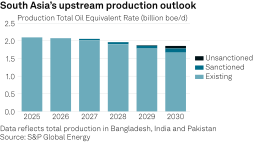
South Asia renews upstream push to guard against future supply shocks
HIGHLIGHTS
India, Bangladesh, Pakistan step up domestic exploration efforts
Supply shock amid Middle East war highlights energy security risks
Regulatory hurdles, other issues may curb international interest
South Asian countries have stepped up efforts to find oil and gas at home as the Middle East conflict has exposed supply vulnerabilities and sent shockwaves through domestic energy markets, but structural, regulatory and commercial challenges will limit international oil companies' interest in investing in the region's upstream sector, industry sources and analysts said June 8.
As energy security takes center stage, governments have signaled a clear intent to push upstream ambitions with renewed vigor. While India has a strong structural framework and ample resources, it faces hurdles to commercial competitiveness. Bangladesh is pursuing reforms and strengthening fiscal terms, yet political turbulence remains a constraint. Pakistan, meanwhile, continues to grapple with macroeconomic instability, they added.
"The recent developments in West Asia have served to underscore the importance of the upstream agenda, bringing into sharper focus the strategic value of domestic hydrocarbons," Manish Maheshwari, founder and chairman of Invenire Energy, told Platts, part of S&P Global Energy. "In that sense, energy security is no longer viewed solely through the prism of affordability and availability. It is increasingly recognized as a cornerstone of economic resilience, national competitiveness and sustainable growth."
For years, countries like India, Bangladesh and Pakistan have leaned heavily on imported oil and gas to run factories and fuel cars. Now, with global supply routes at risk, they face the harsh reality of rising energy bills and supply disruptions. To shield their economies from future shocks, governments are keen to invest in drilling domestic wells to boost local oil and gas production, industry sources and analysts said.
"The Indian subcontinent is confronting a renewed energy security imperative. India, Bangladesh and Pakistan are intensifying efforts to expand domestic upstream activity through accelerated exploration, improved fiscal regimes and targeted policy reforms aimed at attracting global international oil companies," said Rahul Chauhan, senior principal upstream analyst at S&P Global Energy CERA. " However, while the strategic intent is aligned across the region, execution challenges -- ranging from regulatory bottlenecks and political uncertainty to pricing clarity -- continue to hinder upstream investment inflows."
Policy overhaul
Indian Petroleum Minister Hardeep Singh Puri said May 11 that New Delhi had simplified several policies under the Oilfields (Regulation and Development) Act to facilitate international participation, such as rationalization of royalty rates.
On June 5, Puri said that under the National Deep Water Exploration Mission program, a large number of deepwater and ultra-deepwater exploration wells are planned in offshore basins to fully tap India's hydrocarbon reserves. Hydrocarbon presence has been reported in two of the three exploratory wells drilled by Oil India Ltd. in the current exploratory campaign off the Andaman Basin.
"This presence of natural gas will help us in taking forward our exploration ambitions in coordination with global deepwater exploration experts like Petrobras, TotalEnergies, BP India, Shell and ExxonMobil," he said.
According to CERA, for India to unlock global capital, particularly in high-risk basins, it may need to go beyond regulatory simplification and adopt more competitive fiscal structures, potentially reintroducing elements of risk-sharing or differentiated terms for frontier exploration. Until then, the gap between policy intent and actual investor participation is likely to persist.
"This crisis has brought us to a point requiring a deep dive into India's massive unexplored sedimentary basins, as well as unconventional basins, which, like the US, can be a game changer," said Rahul Patel, managing director and CEO of US-based Transcontinental Energy Services.
Arun Kumar Singh, chairman and CEO of ONGC, told an investors' call on May 27 that high oil prices would provide the company with an incentive to boost exploration activity and raise the share of domestic oil and gas production. ONGC is executing nearly $3.4 billion in projects in the Western Offshore, which accounts for about 60% of the company's oil output and 70% of its gas.
ONGC is also engaging multiple global technical experts and specialist partners to address complex reservoir and geological challenges in the Krishna Godavari Basin and to support production stabilization and reverse production decline across key assets, company officials said.
"India's energy future will be built on diversification and exploration," Ratnesh Kumar, executive director at ONGC, told a conference earlier this week. "Energy security, GDP growth and decarbonization are not competing goals. They require a broad, balanced strategy that harmonizes all three."
Bangladesh, Pakistan
Bangladesh launched an offshore bidding round on May 24, offering 26 hydrocarbon blocks for exploration to IOCs, Minister of Power, Energy and Mineral Resources Iqbal Hasan Mahmood said. 11 of the blocks are in shallow waters, and 15 are in deepsea areas of the Bay of Bengal, according to a document from state-run Petrobangla.
Petrobangla has enhanced the draft production-sharing contract to attract IOCs in the bidding round, Mahmood said. The initial exploration period will be six years, with a possible three-year extension, he said, adding that IOCs will be allowed 100% cost recovery for both shallow- and deepwater blocks, with an annual maximum limit of 75%.
"Bangladesh's upstream outlook reflects a policy-driven attempt to reset investor sentiment, with materially improved fiscal and contractual terms. However, the success of the 2026 bid round will ultimately depend on whether the government can deliver consistency, transparency and political stability, which remain the decisive factors for participation of IOCs in the country's upstream sector," Chauhan said.
In the 2012 bidding round in Bangladesh, three shallow-water blocks and one deepwater block were awarded to contractors. There were two other rounds in 2017 and 2024, but neither attracted investor interest.
The awarded blocks are in the Indus and Makran offshore basins, adjoining the territorial waters of Sindh and Balochistan. The Offshore Bid Round 2025 drew bids covering about 54,600 square kilometers of Pakistan's offshore area, resulting in the award of 23 offshore blocks.
"While Pakistan's latest bid round signals a clear intent to revive upstream activity, attracting IOCs will depend on delivering regulatory stability, ensuring contract stability, improving fiscal competitiveness and ensuring credible investment protection, particularly for high-risk offshore exploration. Without these structural improvements, the country's substantial offshore potential may remain underexplored, with investment limited largely to domestic and mid-tier regional players rather than global upstream leaders," Chauhan said.
