Refined Products, Crude Oil, Gasoline
June 08, 2026
US gasoline stocks near critical low as exports face summer strain: CERA

Editor:
HIGHLIGHTS
Refiners face surging crack spread margins
Export capacity to hit effective limit soon
US gasoline inventories are approaching operational minimums that could force a sharp pullback in exports just as the peak summer driving season intensifies demand, threatening to push refining margins to record levels, according to S&P Global Energy CERA.
"If you just follow the trajectory down, very similar to what happened in 2025, sometime in the next few weeks we will reach a level where the US can't go much lower," Richard Joswick, head of oil pricing and trade flow analytics at CERA, said in a June 4 webinar.
"It's not an absolute minimum operating number -- no one knows what that is -- but it's an effective limit on exports," he said.
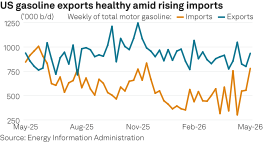
Total US gasoline stocks have declined steadily since late February and are now tracking below 2025 levels, reflecting surging exports to offset global supply disruptions from the effective closure of the Strait of Hormuz.
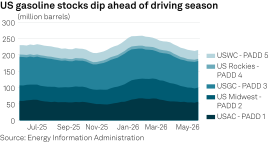
Combined US commercial crude and product inventories have fallen approximately 480 million barrels from late February through May 22, averaging draws of 5.7 million barrels/day, according to Energy Information Administration data.
Regional supply tightens
The constraint stems from operational realities in petroleum supply systems. When storage tanks are depleted, exporters cannot accumulate sufficient volumes to fill vessels efficiently, effectively capping export capacity regardless of price incentives.
The supply squeeze is most acute on the US Atlantic Coast, where stocks have drawn more sharply than the national average. The region's dependence on waterborne supply from the US Gulf Coast and limited local refining capacity -- which has declined by about 400,000 b/d since 2019 -- has amplified the tightness.
Waterborne imports of gasoline and motor gasoline blending components into the Atlantic Coast averaged 537,000 b/d in May and have risen to 664,000 b/d in June as of June 8, according to S&P Global Commodities at Sea data.
Despite the extension of the Jones Act waiver allowing non-US-flagged vessels to move between US ports, only about 50,000 b/d of gasoline moved from the Gulf Coast to New York Harbor in May.
The price of space on Colonial Pipeline's main gasoline line has averaged a 4.30 cents/gallon discount so far in June as of June 8, compared with a 1.38-cent/gal discount in June 2025, according to Platts assessments, indicating weaker demand.
Platts is part of S&P Global Energy.
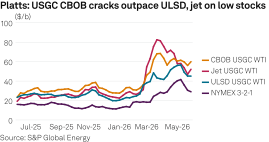
Analysts forecast Gulf Coast CBOB gasoline crack spreads -- the margin refiners earn above crude oil costs -- will surge from around 25 cents/gal to about 50 cents/gal, approaching or exceeding record levels set in April when Dated Brent crude briefly touched $147/barrel.
The crack spread expansion reflects both tight supply and strong seasonal demand. The US is entering peak summer driving season, with gasoline stocks already constrained and limited ability to import additional supply from traditional sources, according to CERA analysts, noting that exporters from Asia -- including China, Thailand and South Korea -- have restricted product exports, while European markets are dealing with their own supply tightness, particularly for jet fuel.
US refiners are responding by maximizing gasoline production, but they face constraints from high-octane component costs, according to Joswick.
Joswick said that octane blending economics have deteriorated as Asian steam crackers curtail operations due to reduced Middle East naphtha exports, tightening global supplies of high-octane blending components, including reformate and aromatics.
Despite these challenges, the blending incentive for naphtha into gasoline has remained stable. Naphtha prices have weakened relative to gasoline, enabling continued blending even as absolute octane costs have risen, he added.
Recovery timeline
The supply-demand balance is expected to remain critically tight through August and September.
Even if the Strait of Hormuz reopens by late July -- the base case scenario in S&P Global Energy's analysis -- the physical rebalancing will take months. Crude oil must transit from the Middle East to USGC refineries, a voyage that takes about 30 days, before additional gasoline production can begin flowing to markets.
Product stock draws are forecast to continue through September, even as crude stocks begin recovering in August following a possible reopening of the Strait. This lag reflects the time required for crude to reach refineries, be processed into products, and accumulate in storage tanks sufficient to rebuild inventories.
CERA analysts emphasized that the US is not expected to experience actual gasoline shortages -- defined as an inability to obtain fuel at prevailing prices. The market will rebalance through higher prices that simultaneously curtail demand and incentivize maximum domestic production while reducing exports.
The situation represents a dramatic reversal from pre-conflict expectations, the analysts said.
Before the effective closure of the Strait of Hormuz, CERA analysts had forecast a stock build of nearly 200 million barrels through the second quarter 2026. Instead, those anticipated builds never materialized, effectively providing an additional 200 million barrel buffer that has been consumed alongside the 480 million barrels in actual stock draws.
