Crude Oil
June 07, 2026
Rosneft's Sechin warns Hormuz crisis threatens long-term oil demand

Editor:
HIGHLIGHTS
Sees Brent averaging $95-$96/b by year-end if route reopens
Shipping via the route at 10% of pre-war levels
Urals discount narrows to $24.25/b amid US sanction waivers
The CEO of Russia's largest oil producer Rosneft, Igor Sechin, said June 6 that tensions in the Strait of Hormuz will keep supporting oil prices for some time, undermining long-term oil demand and triggering a renewed surge of interest in alternative energy.
Sechin said that, even if restrictions on the key Middle Eastern shipping route were lifted immediately, oil prices could average $95-96/b by year-end, according to a company statement, citing Sechin speaking at the St Petersburg International Economic Forum.
"It will take about six months to restore positive dynamics. And then in a year we will observe about $80-85/b, because restoring supplies alone requires significant time and investments," Sechin said, according to the Rosneft statement.
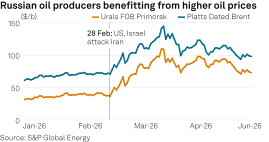
Tanker traffic through the Strait of Hormuz has collapsed to around 10% of pre-war levels following US and Israeli attacks on Iran on Feb. 28, according to S&P Global Energy CERA estimates. The disruption has triggered extreme volatility in oil markets, with Platts assessing Dated Brent at $97.84/b on June 5, within a range of $77.81/b to $144.42/b since the conflict began. Platts is a part of S&P Global Energy.
Sechin warned that the Hormuz crisis is a precedent and threats now loom over other crucial supply routes, including the Strait of Malacca, the Bab al-Mandab Strait, Gibraltar, the Cape of Good Hope, the Danish and Turkish straits, as well as the Suez and Panama canals.
The crisis has led the US to introduce sanction waivers for Russian oil exports since mid-March. Renewed on a monthly basis, the current waiver is in place until June 17 and applies to Russian crude and oil products loaded before April 17, according to the general license posted on the US Treasury Department's website.
Urals discount
The waivers have driven a significant narrowing in the discount on Russian crude. Platts assessed Urals Primorsk at a $24.25/b discount to the Med Dated Strip on June 5, compared with around $35/b before the first waiver was announced.
Sechin said that, if more sanctions are imposed on Russia and 7 million b/d of Russian oil exports are restricted, then around $100/b could be added to oil prices.
He said that, even with harsher sanctions, however, Russia would continue to supply significant volumes to the global market.
"The increased price level will compensate for the shortfall of sanctioned volumes," he said.
Despite the waivers, Russia has struggled to increase crude output. It produced 9.1 million b/d in April, according to the Platts OPEC+ crude production survey, down from 9.23 million b/d in January.
Rosneft accounted for a significant proportion of this, reporting liquids production of 3.74 million b/d in the first quarter.
Sechin said that US companies have been the main beneficiaries of the Middle East energy crisis, as they have "gained non-competitive advantages and the ability to organize supplies at a high price."