Crude Oil, Natural Gas
June 04, 2026
Pro-business presidential win could unlock Colombia's oil and gas sector: analysts

By Sheky Espejo
Editor:
HIGHLIGHTS
Interest in Latin America's upstream grows
Crude output falls on President Petro's policies
Consultations may block project progress
Colombia's June 21 presidential election could reopen the country's oil and gas industry if business-friendly candidate Abelardo de la Espriella wins, although passing any reforms would face significant obstacles, according to industry sources.
De la Espriella led the May 31 election against Iván Cepeda but did not secure a majority, resulting in a second-round election scheduled June 21.
Cepeda is an ally of President Gustavo Petro, who took office in 2022, pledging to reduce Colombia's dependence on fossil fuels, halt the awarding of new oil and gas exploration contracts, and advance the transition to renewable energy.
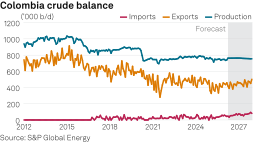
Colombia's crude and condensate production has gradually declined from over 1 million barrels/day in mid-2015 to 762,000 b/d in April 2026, according to S&P Global Energy CERA data. As a result, it has become more dependent on energy imports.
The production decline can be attributed to a combination of lower investment, logistical challenges and public order issues in the producing regions, according to analysts.
"Petro's main banner was to be against the industry, and he worked hard to send the message to communities that companies were the enemy," said Silvia Ardila, director for Latin America at Speyside, an international advisory company specializing in corporate affairs and public policy.
If De la Espriella is victorious, he has promised he will "unlock the regulatory door," and there is hope he could do it, Ardila said.
Oil industry supporters hope the "outsider" could take the necessary measures to "put the house in order," he said.
GeoPark looks to fracking
Felipe Bayón, CEO of Colombia-based GeoPark, said June 3 there is a greater possibility that Colombia will allow fracking if De la Espriella wins.
Bayón said this is where Vaca Muerta serves as an example for Colombia, given that Argentina went through a similar decline under a previous government, which turned the country from a net exporter into an importer. That changed with better conditions and the development of Vaca Muerta, which Bayón said is now producing five times more natural gas than all of Colombia.
This anti-hydrocarbon political stance in Colombia was a driver for GeoPark to buy two blocks in Vaca Muerta in 2025, where it aims to take production from zero to 20,000 barrels of oil equivalent/day by 2028.
This experience can then be applied to shale plays in Colombia, such as La Luna.
"After Sunday's elections, we are a bit more hopeful that the new government will support the industry and allow fracking in Colombia," Bayón said.
Growth is also coming from other Latin American countries, notably Brazil and Guyana.
Maria Fernanda Raggio, exploration director with Argentina's YPF, said June 3 that with the surge in international oil prices this year, more companies are looking for alternative sources to grow production and are taking more risks in exploration.
"The South Atlantic is becoming a very important hot spot," she said. "The global scenario is making this possible."
More companies have been looking at this region since large offshore oil was found in Namibia starting in 2022, she said, pointing out that all the deepwater acreage in Uruguay is fully licensed.
Uruguay is seeing a rise in farm-in deals on the back of big discoveries in Namibia, with US-based APA preparing to drill a well that could unleash more drilling in the undeveloped deepwater basin, Pablo Gristo, exploration and production manager of the national oil company ANCAP, said June 3.
Quick response
In 2024, Colombia's proven oil reserves were 2.04 billion barrels, according to the National Hydrocarbons Agency.
If a new government were to ease restrictions, the sector's response could be almost immediate, Andrés Felipe Calderón Sánchez, vice president for Latin America at energy consultancy Welligence, said.
"It's a very elastic industry," Calderón Sánchez said, adding that in the past, drilling has significantly increased when conditions are favorable.
There was a drought in licensing during the Petro administration, but there had been plenty of contracts awarded before, which had not been fully developed, Calderón Sánchez said.
"There is an inventory, but participants have been reluctant to fully commit to their development," Calderón Sánchez said. "If they fulfill their commitments, then activity would increase with what is already on the table."
A larger opening, which would include new rounds, would take time, he said.
More fossil fuels
The hydrocarbons sector remains paramount for Colombia, as the country is expected to increase its reliance on fossil fuels to face El Niño, according to Andrés Duarte, head of financial analysis at Corfi Colombiana, a Bogota-based investment bank.
According to International Monetary Fund estimates, hydrocarbons account for about 35% of exports and roughly 10% of fiscal revenue.
Roughly 90% of Colombia's electricity is produced using hydroelectric infrastructure. However, when rainfall falters, the country has to resort to other fuels, such as gas, Duarte said.
"The country already uses more natural gas; the current deficit will increase given the need to generate electricity using thermal plants, and offshore gas will be available by the end of the decade, at best," Duarte said.
Colombia's Ecopetrol has partnered with Brazil's Petrobras to increase gas production from the GUA-OFF-0 block in Colombia's offshore Guajira Basin.
Petrobras made its third natural gas discovery offshore Colombia earlier this year, the company said March 18.
In December 2024, Petrobras and Ecopetrol estimated that the deposit could hold as much as 6 trillion cubic feet of gas in place, which would triple Colombia's gas reserves.
Potential challenges
If elected, de la Espriella will face challenges opening the oil and gas industry, observers said.
The first thing a new government must do is gain the industry's trust and provide security, Calderón Sánchez said. The incoming president would also have to find cooperation with the other powers in the country, like Congress, he said.
For their execution, all projects must obtain authorization from communities via consultations, which come on top of a regulatory burden that is already seen as long and complex, observers said.
"Consultations must be redesigned so that all interaction between the communities and the private sector is always mediated by the government," José Manuel Restrepo, who would become vice president of Colombia if de la Espriella were to win the runoff, said in a June 3 interview on Bogota-based Blu Radio.
