Crude Oil, Refined Products
June 03, 2026
Panama Canal congestion hits yearly high, prompting Jones Act waivers

By Binish Azhar
Editor:
HIGHLIGHTS
Canal congestion reaches 2026 peak levels
US grants 41 Jones Act waivers this year
June maintenance to cut daily transit slots to 16
Panama Canal congestion has climbed to the highest levels this year, prompting US authorities to grant multiple Jones Act waivers for domestic shipments even as the canal authority pledged to maintain full transit capacity through December despite looming maintenance and El Niño risks.
The Panama Canal Authority will conduct a dry chamber overhaul from June 9-17, reducing daily transit slots to 16 from the current operational capacity of 36-40 transits, according to shipping analysts at BIMCO.
The maintenance comes as wait times have already climbed to 3.2 days for southbound vessels and 2.3 days for northbound traffic, with average waiting periods rising 50% year over year to 47 hours, the analysts said.
"So far this year, ship transits via the Panama Canal have increased 8% year over year to a daily average of 38, driven by the tanker sector," Filipe Gouveia, shipping analysis manager at BIMCO, said, driven by surging US energy exports to Asia and the Americas' West Coast following the Strait of Hormuz closure.
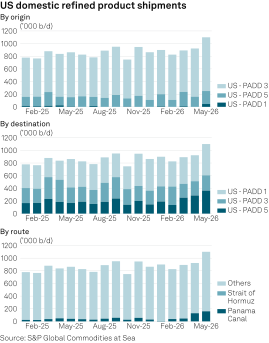
The growing backlog has driven the US Maritime Administration to issue Jones Act waivers allowing foreign-flagged ships to transport goods between US ports, particularly to the West Coast.
In 2026 so far, 21 waivers have been granted to vessels en route from the US Gulf Coast, 11 from the West Coast and nine from the Atlantic Coast, all bound for West Coast destinations, according to MARAD.
| Jones Act Waivers | |
| Route | West Coast |
| US Gulf Coast | 21 |
| West Coast | 11 |
| Atlantic Coast | 9 |
The Merchant Marine Act of 1920, known as the Jones Act, requires that ships transporting merchandise between US points must be US-built, US-owned and US-flagged.
The Jones Act waivers provide an alternative for domestic US shipments, allowing foreign vessels to move cargoes between US Gulf Coast and West Coast ports without transiting the canal.
Platts last assessed the Jones Act Medium Range term-charter rates steady at $91,000/day May 27 for the 10-15 year-old tonnage band, up from $88,500/d early January.
Container ships, LPG carriers, oil tankers and bulk vessels account for 77% of canal transits, with container operators typically booking slots ahead of other sectors that bid closer to transit dates.
The recent demand spike has particularly affected tankers and bulk carriers competing for available slots.
"The recent spike in demand has inflated auction prices," Gouveia said.
Weather concerns
The congestion is set to worsen during a scheduled dry chamber overhaul on the Gatun Locks' east lane June 9-17, when daily transit slots will fall to 16.
Forecasts show that a 61% probability of El Niño conditions developing between May and July could further constrain capacity if reduced rainfall lowers water levels in Lake Gatun, the canal's main freshwater source, Gouveia said.
However, the Panama Canal Authority said May 18 that current data does not forecast the need for transit restrictions through Dec. 31, even as it conducts the June maintenance.
The authority said it has maintained Gatun Lake at historically high water levels since late 2025, when it began implementing water-saving measures at the locks in anticipation of potential El Niño conditions.
The canal took advantage of Panama's 2026 dry season, which ranked among the wettest since 1950, to strengthen water reserves in Gatun and Alhajuela lakes while maintaining 38 daily transits.
During the last El Niño event in 2023-24, daily transits fell to 22 ships between December 2023 and January 2024 at maximum draughts of 13.4 meters, 12% below normal levels, forcing widespread supply chain adjustments, according to BIMCO.
The congestion could prompt operators to consider alternative routes via the Cape of Good Hope or Cape Horn, which involve longer voyages and higher bunker costs but eliminate canal transit fees and provide scheduling flexibility.
Demand for Panama Canal transits is expected to remain elevated as long as Strait of Hormuz disruptions persist and US energy exports stay strong, with congestion potentially intensifying in the medium term beyond the June maintenance period.
