Crude Oil
June 03, 2026
Oil in spotlight as Venezuela's Rodríguez visits India amid supply woes, shifting flows
HIGHLIGHTS
Venezuela's Delcy Rodríguez to visit India June 3-7
India snapping up Venezuelan crude amid supply woes
About 9.5 mil barrels set for June discharge at ports: CAS
India's growing appetite for Venezuelan crude will be in the spotlight during acting President Delcy Rodríguez's visit to New Delhi this week, as the two countries look to expand energy ties amid a prolonged Middle East conflict and disruptions to flows through the Strait of Hormuz, which are reshaping the global oil flow map, government officials, industry sources and analysts said June 2.
The diplomatic visit comes at a time when India is rapidly acquiring Venezuelan crude to fill the gap left by disruptions to Middle Eastern supplies. The South American supplier continues to benefit from a supply agreement with Washington and eased sanctions, which have broadened access to its crude oil for a wider range of customers.
"India has rapidly become a key outlet for Venezuelan crude amid Middle East Gulf supply disruptions. While flows have surged, further upside is potentially constrained by limited heavy-crude processing capacity, with only a handful of refineries able to run grades like Merey-16," said Benjamin Tang, head of liquid bulk at S&P Global Commodities at Sea. "Freight economics will also be critical, but structurally, India will look for opportunities to diversify purchases even further and can use diplomatic relationships to push that agenda."
India's foreign ministry said in a statement June 2 that Rodríguez will visit India over June 3-7 and hold bilateral talks with Prime Minister Narendra Modi on energy flows, as well as mutual trade and investment opportunities.
"India has been an important partner of Venezuela in the areas of energy and investment. Indian public sector undertakings have made significant investments in Venezuela in the energy sector, and they are keen to explore opportunities for further enhancing their presence," the ministry said.
Improving outlook
CAS data showed June 3 that a total of 9.5 million barrels of Venezuelan-origin crude are scheduled to be discharged at India's ports in June, after 8.2 million barrels were discharged in May, indicating a sharp near-term increase in flows.
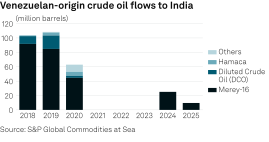
India imported about 300,000 barrels/day of Venezuelan crude in 2019, but flows have since declined sharply, totaling about 25 million barrels in 2024, CAS data showed. In 2025, five VLCCs -- one per month -- discharged Venezuelan crude at the Port of Sikka.
"Venezuela has the potential to become a major crude supplier to India as a partial replacement for Middle Eastern and Russian crudes. Indian refiners have the complexity to be able to easily take heavy Venezuelan crudes," said Tushar Bansal, senior director at consulting agency Alvarez & Marsal.
"At the same time, India can also look to again invest in Venezuelan upstream heavy oil basins as a source of supply security. It is also an opportunity to monetize the past dividends that were stuck in the country," Bansal added.
Indian upstream investors in Venezuela are optimistic that some recent developments and sanctions relief could help recover dividends and facilitate the restructuring of their joint ventures, industry sources and analysts said.
Prioritizing risk mitigation
Indian state-run oil companies entered Venezuela in 2008 to secure heavy crude resources and diversify their upstream portfolios. ONGC's overseas arm, ONGC Videsh, holds a 40% participating interest in the San Cristobal project through its subsidiary ONGC San Cristobal BV, according to the company's website. The project is a joint venture with Venezuela's state-owned oil and gas company PDVSA under Petrolera Indovenezolana SA, or PIVSA.
In 2010, ONGC, along with Indian Oil Corp. and Oil India, participated in the Carabobo-1 project located in the Orinoco Belt. ONGC Videsh holds an 11% equity in the Carabobo project, while IOC and Oil India, through IndOil Netherlands BV, a 50:50 JV, have a combined 7% stake, according to the ONGC Videsh website and S&P Global Energy.
"For now, Indian NOCs are expected to adopt a cautious stance, prioritizing risk mitigation over aggressive growth," said Mansi Anand, principal analyst for research on national oil companies at S&P Global Energy CERA.
As of March 31, 2025, ONGC's cumulative investment in Venezuela was about $770 million, with $529 million in San Cristobal and $240 million in Carabobo-1. Despite these investments, production remains low -- 1,870 b/d from San Cristobal and 970 b/d from Carabobo-1 in fiscal year 2024-25 (April-March) -- contributing less than 1% to ONGC's international output and underscoring operational challenges and geopolitical constraints, according to CERA.
However, changes in Venezuela's geopolitical conditions are gradually enabling increased output.
In May, the average production by Venezuelan state oil company PDVSA and its foreign partners rose to 1.155 million b/d from 1.130 million b/d in April, according to preliminary data from the Ministry of Hydrocarbons. The preliminary data excludes condensate production, which is estimated at 60,000 b/d for May, according to the report.
Production in the Orinoco Belt, Venezuela's main oil-producing area, reached 650,000 b/d in May, 20,000 b/d higher than in April, according to the report. PDVSA expects to reach crude oil production of 1.37 million b/d by December, up 430,000 b/d from the 940,000 b/d recorded in January, said Jovanny Martinez, the company's executive vice president, during a presentation to oil industry executives in Caracas on April 27.
