Chemicals, Crude Oil, Natural Gas
May 29, 2026
India's ONGC eyes petrochemicals trading, ethane shipping in diversification beyond upstream
HIGHLIGHTS
ONGC, MRPL, OPaL to establish petrochemical trading JV
Partnering with Mitsui O.S.K. Lines for ethane shipping
High oil prices an incentive to expand exploration
India's ONGC Ltd is embarking on a series of expansion projects to boost its footprint in petrochemicals trading, as well as energy logistics and shipping, helping the state-run company to diversify its portfolio beyond oil and gas production, company sources said on May 27 and May 28.
Although ONGC is confident about sustained growth in demand for both transport fuels in India for a couple of decades, the moves form a part of a broader strategy to ensure that the country's biggest oil and gas producer is well-prepared to meet the challenges of a fast-changing energy landscape, they added.
"ONGC has entered into multiple new ventures and strategic tie-ups to support production growth, expand into new business verticals, strengthen its renewables footprint, and strengthen its subsidiaries," a company official said May 28.
ONGC said in a statement on May 26 that ONGC, with its group companies MRPL and OPaL, was in the process of establishing a petrochemicals trading joint venture, including third-party sales. The respective boards had already approved the formation of a joint venture company, which is presently under consideration for government approval.
"ONGC has entered into specialized energy logistics by forming two joint venture companies with Mitsui O.S.K. Lines (MOL), Japan, for shipment of ethane to OPaL," the statement said.
ONGC contributes around 73% of India's crude oil and roughly 58% of its natural gas production, the company sources said. The company is deepening its technical and operational expertise in deepwater E&P and is increasingly assessing the prospect of high-pressure-high-temperature and ultra-deepwater plays in India, the sources added.
High prices provide incentive
Arun Kumar Singh, ONGC's chairman and CEO, told an investors' call on May 27 that high oil prices would provide an incentive for ONGC to boost exploration activity and help raise the share of domestic oil and gas production.
"Global outlook of oil price is certainly better for the next two years than it was in the previous two years. So, you will have to draw your own inference to see where ONGC will be," Singh said.
Crude oil futures finished a volatile session little changed on May 28 as US-Iran peace talk headlines continued to dominate sentiment. NYMEX July WTI settled 22 cents/barrel higher at $88.90/b, while ICE July Brent declined 58 cents to $93.71/b. Crude price volatility remained high as risk sentiment ebbed and flowed based on headlines concerning US-Iran peace efforts.
"We are executing almost around $3.4 billion of projects in the Western Offshore," Singh said, adding that Western Offshore contributes roughly 60% of ONGC's oil output and 70% of gas.
Company sources added that geological issues and the conflict in the Middle East had affected ONGC's production recently.
"Geological surprises arising out of reservoir complexities affected the production from the 98/2 Field in Eastern Offshore. The West Asia crisis also affected the pipeline replacement project and the Daman Upside Development Project, affecting the oil and gas production from Western Offshore," the ONGC statement said.
While ONGC's production has remained broadly flat in recent years, the company is taking a series of long-term initiatives to address India's exploration and production challenges, it said.
"Mumbai High field shows strong early signs of production revival within the first year of onboarding of BP as technical service provider, with oil production reaching 102% and gas production reaching 108% of the target baseline. After this success, ONGC is advancing the onboarding of BP for the entire Western Offshore," the statement said.
ONGC was engaging multiple global technical experts and specialist partners to address complex reservoir and geological challenges in the KG basin, supporting production stabilization and reversing production decline across key assets, it said.
Production challenges
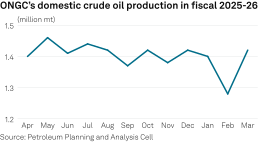
ONGC recorded a 5.3% year-over-year fall in crude production to 4.45 million mt in the January-March quarter, company officials said May 27, reflecting the combined impact of reservoir complexities in oil wells and the West Asia crisis on pipeline replacement.
The flagship explorer crude production fell to 18.36 million mt in 2025-26 (April-March), down 1.1% year over year, they said. The decline in annual output is due to depleting recovery from the company's old assets, including Mumbai High, and delays in output flow from discoveries, including its offshore western assets, the officials said.
India remains heavily dependent on imports to meet its energy demand, with crude oil imports accounting for close to 90% of total imports and natural gas -- including LNG -- imports exceeding 50%, S&P Global Energy CERA said in a report on May 14.
"This structural reliance has been further exposed by recent geopolitical disruptions -- ranging from the Russia-Ukraine conflict to escalating tensions involving Israel, the US, and Iran -- which have heightened concerns over supply security and price volatility. Against this backdrop, the urgency to strengthen domestic hydrocarbon production and accelerate exploration efforts has become more pronounced," it added.
