Electric Power, Crude Oil, Coal
May 28, 2026
Heat wave likely to limit India's near-term demand growth for transport fuels
HIGHLIGHTS
Gasoline, diesel demand growth to slow near term: CERA
Refineries set to maintain runs despite heat impact
Modi appeals to citizens to take precautions as temperatures rise
The heat wave sweeping India is set to take a toll on near-term demand for transport fuels as citizens look to cut travel and reduce outdoor activity, but higher usage of generators for power generation as well as agriculture during the monsoon season could limit the fall in gasoline and diesel consumption, industry sources and analysts said May 28.
While the heat wave has lifted India's power demand to a record high, the impact on fuel oil is expected to be limited as the power sector is largely leaning on coal for incremental electricity generation to fill the gap, they added.
"The severe heat wave in the country is expected to limit transportation fuel demand -- especially in north and central India -- despite an expected early monsoon in the southern regions," said Abhishek Ranjan, South Asia oil research lead at S&P Global Energy CERA.
"In addition to the already disrupted supply chain for oil and rising prices, the extreme heat is projected to exacerbate the deceleration in transportation demand growth, restricting it to below 1% year over year in May-June compared to an average of 4% for the same time period," Ranjan added.
The country's peak power demand hit a record high of 270.82 GW on May 21, marking the fourth consecutive daily record, India's Ministry of Power said in a social media post the same day, with the surge reflecting the impact of severe heat waves across the country. The peak power demand for the country has been gradually growing. On May 20, it stood at 265.44 GW, and on May 19, at 260.45 GW, the Ministry had shared in earlier posts on X.
"Different parts of India are witnessing soaring temperatures and the challenges that come with it. This heat is harsh on all of us, and I urge you all to take as many precautions as possible," Prime Minister Narendra Modi said in a post on X on May 27, adding that it was important to avoid stepping out in peak afternoon hours, especially for the elderly population.
"A strong heat wave can lead to higher usage of generators for power generation and agriculture as well as a greater use of logistics and delivery services," said Tushar Bansal, senior director at consulting agency Alvarez & Marsal. "But transportation fuels demand is expected to reduce seasonally from mid-June onward with the onset of the monsoon. This could be tempered by any further increase in retail pump prices in the case of a continued Middle East conflict."
Prices, throughput
Analysts and refining sources said soaring temperatures would increasingly put pressure on electricity grids, potentially causing blackouts. As a result, a sharp increase in diesel-powered backup generation is expected across many sectors, such as manufacturing, to offset grid failure risks. In addition, extreme heat is set to accelerate reliance on diesel irrigation pumps to keep crops intact.
"The heat wave will force people to reduce mobility and driving. But I don't think overall oil products demand will be affected in a big way. Refineries will maintain their run rates as usual. There will be good demand for fuels from the industrial and agriculture sectors," said DLN Sastri, former director of refining at the Federation of Indian Petroleum Industry.
India's refineries processed 23.5 million mt, or 5.5 million b/d, of crude in March, down 1.7% from 23.9 million mt in March 2025, the data showed. In February, crude throughput totaled 21.9 million mt, or 5.7 million b/d. State-run refiners Indian Oil Corp., Bharat Petroleum Corp. Ltd., and Hindustan Petroleum Corp. Ltd. -- which together account for more than 61% of India's total refining capacity -- operated well above normal monthly levels in March, according to the oil ministry's preliminary update on refinery runs. IOC ran at 117% capacity, BPCL at 112%, and HPCL at 114%.
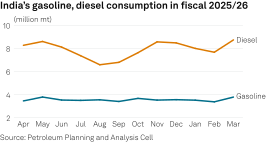
"We have also recently seen price rises for gasoline and diesel at the retail level. This also won't affect demand in a big way, as consumers know the reasons for the rise. Global crude oil prices have gone up substantially," Sastri said.
Indian state refiners on May 15 raised gasoline and diesel prices by Rupees 3/liter -- about 3%-3.5% -- with immediate effect, senior refinery officials said, as energy companies look to recover some of the losses from surging global crude prices. On May 19, state refiners raised gasoline and diesel prices by another 90 paise/liter, an IOC official said, marking the second increase in less than a week. State refiners last increased retail gasoline and diesel prices in April 2022.
Long-term solutions
The latest heat wave is adding a new layer of pressure on India's energy supplies, which are already reeling under the impact of the conflict in the Middle East and disruption to oil flows across the Strait of Hormuz.
Vibhuti Garg and Kaira Rakheja of the Institute for Energy Economics and Financial Analysis said in a recent research note that as extreme heat reshapes electricity demand, the real test is no longer how much renewable capacity India can build, but how effectively it can integrate, store, and use it when demand peaks.
"Peak electricity demand is shifting beyond solar generation hours. Meeting this rising evening demand increasingly requires energy storage. Without adequate storage capacity, the grid continues to rely heavily on thermal power to bridge the gap, raising emissions. At the same time, cooling demand is now driving peak load, and aligning consumption patterns with renewable generation is critical," they added.
Dharmakirti Joshi, chief economist at CRISIL, part of S&P Global Energy, said that prioritizing the use of available domestic energy sources is crucial for ensuring energy security and affordability in times of higher demand and energy supply disruptions.
"Coal is the largest source of primary energy in India, and import dependence on it is low, with domestic production meeting over 70% of demand. Cleaner coal technologies can be adopted, while coal-based power will continue to provide essential baseload capacity, given the intermittent nature of renewable energy. This approach will facilitate faster investments in renewables, particularly solar power, where India has already made significant progress," he said.
"Additionally, accelerating the adoption of nuclear technology to reach a target of around 22 GW by 2031-32 should be a relentless quest," he added.
