Electric Power, Crude Oil
May 26, 2026
Mexico likely to resist major energy policy changes during USMCA talks: panelists

By Sheky Espejo
Editor:
HIGHLIGHTS
Mexico seen content with current situation in industry
Trade surplus in April highlights interdependence
Power shortages drive private investment shift
Mexico is unlikely to make sweeping concessions on the hydrocarbons sector during the upcoming USMCA review process, panelists said May 26, arguing that the current framework already gives the government enough flexibility to attract targeted private participation without reopening politically sensitive constitutional debates.
Although the US is likely to pressure Mexico, Mexico will try to maintain the status quo as much as possible, experts said during a Brookings Institution webinar on the future of US-Mexico relations.
"Mexico's current situation is exactly where it wants it to end up," Christopher Sands said, referring to the country's energy model.
Sands, who heads the center for Canadian studies at the John Hopkins University School of Advanced International Studies, said Mexico has been able to expand its crude production even after the sweeping constitutional reform in the sector.
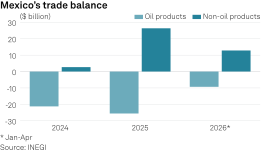
Mexico's trade balance continues to show the interdependence of both countries. Mexico posted a $4.5 billion trade surplus in April; Mexico's non-oil trade continues to offset weakness in the energy balance, as exports surged to a record $72 billion aided by manufactured goods.
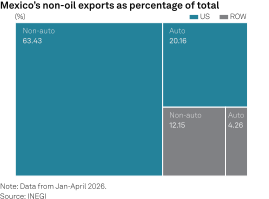
The US continues to be Mexico's main trading partner, with over 80% of the trade.
Mexico recently signed a trade agreement with the European Union, aiming to diversify its economy.
"In the long term, there is a highly dependent energy relationship between Mexico and the US," Sands said.
The comments align with broader industry expectations that Mexico will maintain a pragmatic approach toward private participation in sectors considered critical, even as the government continues to defend state control over strategic parts of the energy industry.
They also align with industry beliefs that the United States-Mexico-Canada Agreement negotiations will address other topics, such as security, migration and drug trafficking, which are central to the US.
Some observers have told S&P Global Energy they expect negotiations to continue until past the US midterm elections in November.
More flexibility
Mexico is becoming more flexible toward private investment, particularly in the power sector, as mounting power shortages threaten industrial expansion and nearshoring ambitions, panelist Pamela Starr, a professor of international relations at the University of Southern California, said during the discussion.
"Mexico's supply of electricity is insufficient to meet the needs of expanding manufacturing, expanding investment and growth that Sheinbaum wants in the economy," Starr said, referring to President Claudia Sheinbaum.
The shift suggests that Sheinbaum's administration is trying to preserve the core of Mexico's nationalist energy framework while making selective concessions to ensure that the country can support growing manufacturing demand and remain competitive within North American supply chains.
The comments come as Mexico moves forward with plans to expand generation capacity under a framework that keeps the state utility CFE, at the center of the power system while increasingly relying on private capital to help develop projects.
Starr added that "the most recent offer for private involvement in the electricity sector in Mexico was oversubscribed," suggesting investor appetite remains strong despite years of regulatory uncertainty under former President Andrés Manuel López Obrador.
Analysts noted that renewable generation projects are advancing more rapidly under the current administration, partly because they can be deployed faster than conventional thermal plants and help alleviate immediate supply constraints.
Starr said electricity generation, particularly in renewables, is "moving forward rather quickly in Mexico right now."
