Natural Gas, Crude Oil
May 15, 2026
Russia's Zarubezhneft to resume work on Indonesia’s Tuna block in June: Indonesia minister
By Mia Pei and Anita Nugraha
Editor:
HIGHLIGHTS
Block targets 115 mil cubic feet gas daily by 2027
Russia to expand upstream investment in Indonesia
150 mil barrels of Russian crude to arrive in 2 weeks
Russia's Zarubezhneft plans to resume work on the long-delayed Tuna gas block in Indonesia's Natuna Sea in June, after the project stalled following the withdrawal of the UK's Harbour Energy, Indonesia's Energy and Mineral Resources Deputy Minister Yuliot Tanjung said May 14.
Tanjung met Zarubezhneft executives in Kazan, Russia, this week during the 14th Indonesia-Russia Joint Commission on Trade, Economic and Technical Cooperation, where the Russian company reaffirmed its commitment to continue the offshore Tuna gas project, according to the Energy and Mineral Ministry's statement.
"We met with Zarubezhneft and discussed the continuation of the Tuna Block project, which is still delayed. Zarubezhneft stated its commitment to continue the project in June, next month. The government will provide support for the continuation of this project," Tanjung said.
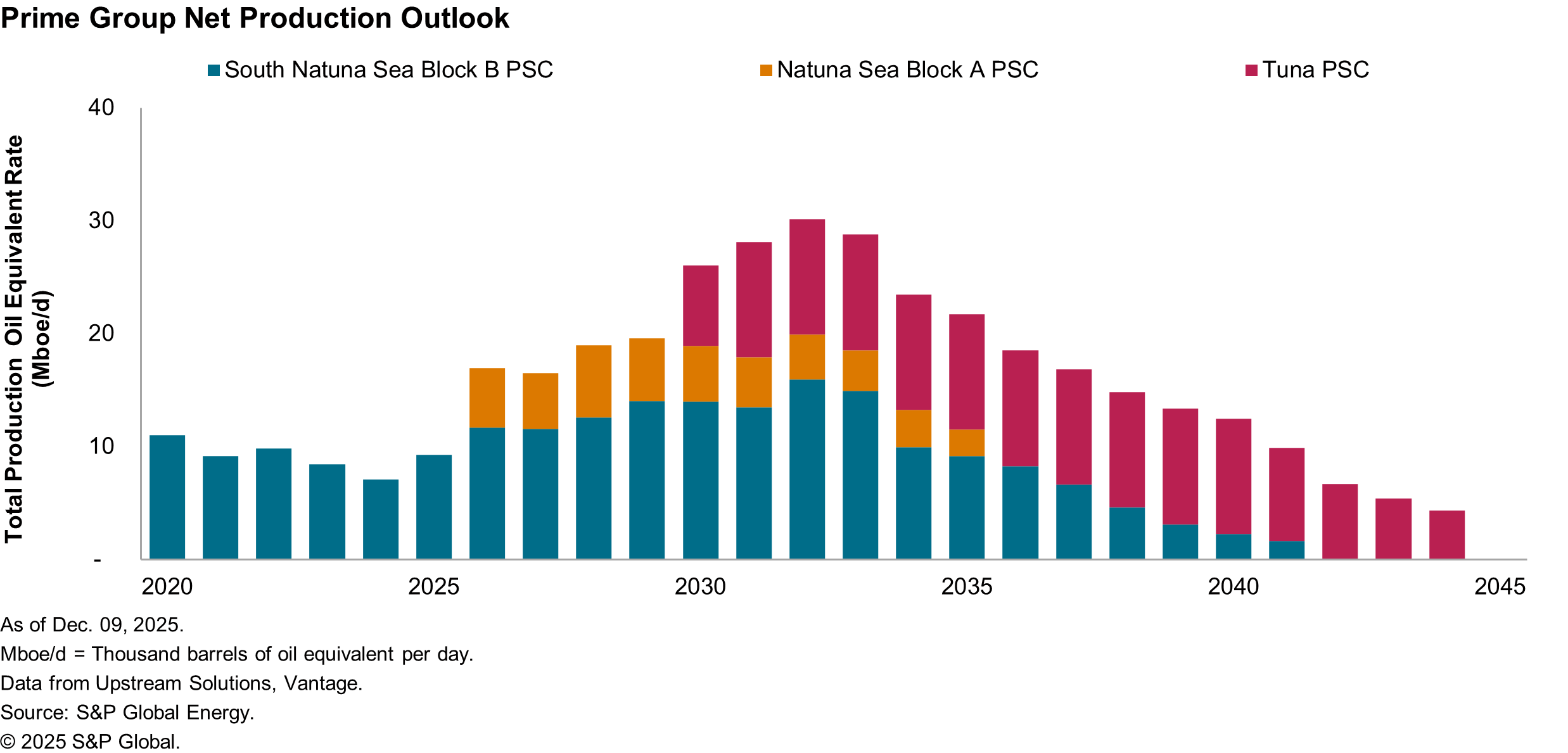
Located near the maritime border between Indonesia and Vietnam, the Tuna block is expected to produce around 115 million standard cubic feet of gas per day from 2027. Indonesia has approved a development plan worth around $3 billion for the project.
Zarubezhneft acquired a 50% interest in the Tuna block in 2020 after the block was first officially awarded to Premier Oil (merged into Habour Energy in 2021) and MOECO in 2007. In 2023, Zarubezhneft had planned to withdraw from the Tuna block amid sanctions imposed by the EU and the UK on Russia, following the outbreak of the Russia-Ukraine war. But the Russian company retained its stake in the project through its subsidiary ZN Asia, while Harbour evaluated options to divest its stake.
Zarubezhneft did not respond to Platts' request for official comment.
In December 2025, Harbour agreed to sell its operating interests in two blocks in Indonesia, including the 50% in the Tuna Production Sharing Contract, to Prime Group, a privately owned company with upstream and downstream oil and gas businesses in Indonesia. The transaction was expected to close in the second quarter of 2026.
Upstream expansion
Besides the Tuna project, Tanjung said that Zarubezhneft also expressed interest in expanding upstream investments in Indonesia, including enhanced oil recovery projects and the reactivation of idle wells to help raise national oil and gas output.
Russia also requested Indonesia's support in completing compliance procedures for companies nominated by Zarubezhneft to organize crude oil supplies to Indonesia, according to the government statement.
Indonesia's relations with Russia have grown warmer since Indonesia joined BRICS under President Prabowo Subianto, who was inaugurated in October 2024. Indonesia seeks to boost oil and gas production to support its energy self-sufficiency target. With domestic energy demand still rising, Indonesia has been broadening cooperation with major energy producers such as Russia, the US, and several African countries.
Indonesia will import up to 150 million barrels of Russian crude oil through the end of the year, while also exploring wider cooperation in areas such as oil storage, long-term crude and LPG supply, nuclear energy, and mineral processing, following talks in Moscow between Russian President Vladimir Putin and his Indonesian counterpart.
Energy and Mineral Resources Bahlil Lahadalia told reporters in early May at a doorstep that the import deal and the related contracts between the two parties have been completed. Crude oil is expected to start arriving in Indonesia within the next 1 to 2 weeks.
Beyond upstream cooperation, Indonesia and Russia are also developing a planned 300,000-barrel-per-day refinery and petrochemical complex in East Java through a joint venture between state energy company Pertamina and Russia's Rosneft. The final investment decision is still ongoing.
