Refined Products, Gasoline
May 15, 2026
Nigeria's Dangote sues government over fuel import policy
By Kelly Norways and Newsdesk-Nigeria
Editor:
HIGHLIGHTS
Refinery able to fully meet domestic demand
Tranche of new import licenses recently issued
Nigeria's Dangote oil refinery has taken legal action in Nigeria's High Court challenging the government's policy on imported fuel, a company executive has said.
With its 650,000 barrel/day refinery, the largest in Africa, the Dangote Group has long maintained it can fully cater to Nigeria's domestic fuel needs. It has consistently lobbied for tougher controls on foreign fuel, and has disputed the government's decision to continue issuing local marketers with import licenses.
Devakumar Edwin, Dangote's vice president for oil and gas, said May 14 that the company had taken legal action after a push from Nigeria's downstream regulator to allow more imports as the refinery has hit record output volumes. The case appeals to the provisions of Nigeria's Petroleum Industry Act and calls for clarity on protections for the domestic market.
The Nigerian Midstream and Downstream Petroleum Regulatory Authority, which allocates the licenses, recently sanctioned six companies to import 720,000 metric tons worth of gasoline in the second quarter, relaxing a more restrictive stance that has been in place since October.
A spokesperson for the NMDPRA May 15 declined to comment on the case and said it was a matter for the attorney general.
The swathe of new license approvals coincided with the regulator's second leadership change in the space of five months, which installed a former Dangote Cement sales director as its new CEO. It also follows rising fuel prices amid the ongoing conflict in the Middle East, which has almost doubled the price of gasoline on an FOB West Africa basis to $1,180/mt, according to Platts assessments from S&P Global Energy.
The lawsuit follows a previous case brought by Dangote against the state-run Nigerian National Petroleum Company, previously the chief importer of the country's fuel. After commencing its operations in 2024, Dangote sued NNPC over its continued gasoline imports, but later withdrew the legal challenge.
NNPC has since mostly exited the import market, leaving a handful of oil marketing companies to apply for licenses. In late 2025, the Nigerian presidency also recommended the implementation of a 15% import tariff to support domestic production, but the proposed duty was later abandoned after public criticism over inflationary concerns.
Import quality concerns
Dangote officials have alleged that substandard imports have threatened to undercut its own supply, which meets Euro 5 specifications and supported a national shift to new fuel quality standards in 2024.
In a recent interview with Platts, David Bird, CEO of the Dangote refining business, expressed concerns over imports of high-sulfur diesel and other low-quality products still making their way into the country, where authorities lack the testing capacity to properly enforce standards, he said.
"The only reason that we could be undercut is through inferior or sanctioned products," Bird said. "We are more than happy to compete on level playing field from a product quality perspective," he said.
Through a combination of crude processing and blending activities, the refinery has so far produced a maximum gasoline quantity of 96 million liters/day, and has the capacity to grow its output to 100 million l/d, Bird said.
The site can supply its gasoline to the market by truck or through coastal exports, although storage limitations can restrict its ability to produce at full capacity without better certainty over local demand, he said.
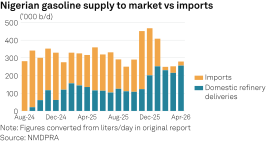
The Dangote refinery produced 53.6 million liters/day of gasoline in April, or roughly 340,000 b/d, against some 320,000 b/d of domestic demand, according to the latest NMDPRA figures published May 13.
However, actual deliveries to the market lagged national consumption, amounting to roughly 255,000 b/d. By comparison, gasoline imports totaled 3.7 million l/d, or around 20,000 b/d.
The Dangote refinery hit its full nameplate capacity for the first time in February, and has run at more than 90% utilization through March and April, according to the regulator's data.
