Crude Oil, Refined Products, Diesel-Gasoil
March 17, 2026
South Korea-Australia energy ties gain urgency amid Middle East supply risks

By Gawoon Vahn
HIGHLIGHTS
Ministers Cho, Wong discuss energy security partnership
Australia supplies condensate; South Korea exports fuels
South Korean refiners buyers of NWS, Ichthys condensate
South Korea and Australia are seeking to strengthen their collaboration to bolster energy security, leveraging each other's strengths in upstream and downstream sectors amid heightened global uncertainty over crude and fuel supplies due to the Middle East conflict, according to the foreign affairs and trade ministries.
South Korea's Minister of Foreign Affairs Cho Hyun held a telephone conversation with Australia's Minister for Foreign Affairs Penny Wong at her request, during which the two ministers exchanged views on bilateral relations -- including cooperation on energy security in light of the recent situation in the Middle East, MOFA said in a statement March 16.
Regarding logistical challenges with Middle Eastern crude oil and gas imports, Minister of Trade, Industry and Resources Kim Jung-kwan emphasized that securing and strengthening alternative supply sources from non-Persian Gulf producers, such as Australia, is essential, according to a MOTIR policy briefing report March 17.
Australia is a leading producer of condensate, or ultra-light crude, in the Asia-Oceania region and could supply more essential raw materials to South Korea -- Asia's top supplier of clean oil products -- according to feedstock managers and low-sulfur crude traders at three major South Korean refining and petrochemical companies, including Hanwha TotalEnergies, who spoke with Platts during market discussions over March 5-17.
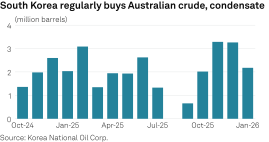
South Korean refining and petrochemical companies have been regular buyers of North West Shelf condensate for decades. The new Ichthys condensate has also quickly become a preferred feedstock grade, according to refinery feedstock managers in Seoul, Seosan and Ulsan, who spoke with Platts over March 12-16.
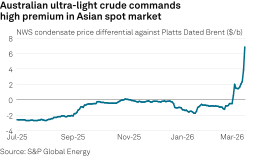
Platts, part of S&P Global Energy, assessed Australia's flagship North West Shelf condensate at a premium of $6.85/b to Dated Brent on March 16, marking a record-high premium for the ultra-light crude grade.
South Korea imported 2.18 million barrels of mostly ultra-light crude from Australia in January, up 7% year over year, the latest data from state-run Korea National Oil Corp. released Feb. 27 showed.
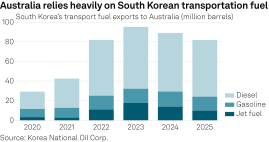
Meanwhile, South Korean refiners exported 205.39 million barrels of diesel in 2025, with Australia as the largest customer, importing 57.71 million barrels and accounting for 28.1% of the export market, KNOC data showed.
South Korea is also a key exporter of gasoline to Australia, having shipped 5.08 million barrels -- 18.39% of its total auto fuel exports -- to the country in December 2025, preliminary data from the Department of Climate Change, Energy, the Environment and Water showed.
Cho emphasized the growing importance of energy security amid recent developments in the Middle East and proposed that South Korea and Australia, as like-minded countries in the region and close partners in energy cooperation, continue to communicate and collaborate closely, MOFA said in the statement.
Term supply customers
Although Asian clean oil product crack spreads have rallied recently, South Korean refiners may not be able to fully capitalize on the strong margins by increasing spot cargo sales, as their top priority is to fulfill term supply contractual volumes for major customers across the Asia-Pacific region.
"Term supply for March- and April-loading gasoil/diesel cargoes [bound for Australia] will be met, though it could become very difficult to fulfill contractual volumes from late April onward if disruptions to Middle Eastern crude feedstock arrivals persist for several more weeks," a product marketing manager at a major South Korean refiner in Ulsan told Platts on March 16.
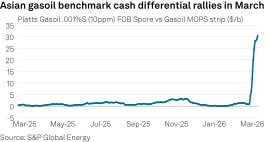
Platts assessed the FOB Singapore 10 parts per million sulfur gasoil cargo cash differential at an all-time high of plus $36.18/b on March 16.

Editor: