Chemicals, Polymers, Olefins
October 01, 2026
Americas PP market faces weak October demand, Brazil expects modest uptick
Editor:
HIGHLIGHTS
US PP exports stay tight through October: source
Mercosur buyers delay purchases, await quotes
Brazil anticipates demand rise post-holiday
US
US polypropylene market participants expect export availability to remain tight into October, given current supply tightness stemming from production issues, which is enabling producers to remain firm on offer levels.
Export allocation remained limited throughout September, and sources expect supply to stay constrained in October, as Lyondell Basell's Lake Charles complex is undergoing a turnaround.
On the demand side, although arbitrage to South America is expected to remain open given higher PP prices from China, demand from Latin America is expected to remain subdued.
"Converters have enough inventory, and they can stretch it to December," a second PP trader said. "Customers think there will be another price correction."
The domestic US PP market is also expecting a price correction, which prompted buyers to hold back on purchases and wait for the market to reach a bottom.
"Everybody is waiting to buy at the bottom of the market," a domestic trader said. "We're expecting buying appetite in November and December."
Demand was weak as converter inventory was described as stable and buyers were on hold. In addition, there was bearish sentiment from the upstream polymer-grade propylene contract that settled 2 cents/lb lower for September.
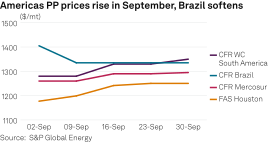
Mercosur
Markets in Mercosur were mostly quiet in September. Typically, sellers wait for guidance from regional resin suppliers to set their own offers. However, one of the largest local PP producers took longer than usual to set its monthly quotations. Once quotations became available, buyers rushed to replenish stocks, then shifted to a wait-and-see mode, pushing pricing discussions to October and, for the most part, disengaging from traders.
"Not heard any prices this week," said a distributor source in the region on Sept. 21. "Everyone is just waiting for October quotations."
The regional mood for next month points to a market still dominated by regional product, as a second distributor noted that one of the largest producers in South America "is being very aggressive, trying to get market share, especially on PP." At the same time, imports continue to be dismissed due to concerns among purchasers about pricing volatility and risks associated with long delivery times.
"Freight costs from China are now dropping, but from other origins are either high or rising, so everything gets kind of mixed," said a supply-side source. "It's difficult to come up with a conclusion for current and incoming pricing," because anything can happen during the 90-day transit time with domestic and import prices.
Brazil
Brazilian PP market participants expect October to see improved demand compared with September, but still at reduced levels, as market participants believe that freight rates from China to Brazil will drop and price margins will start to readjust.
"I have started hearing that the freight from China to Brazil might start dropping after the Golden Week holiday," a Brazilian converter said. "After that, they will want to move to selling activity already for 2027 delivery cargoes."
Platts, part of S&P Global Energy, assessed the container rate from North Asia to East Coast South America on Sept. 30 at $6,600/FEU ($264/mt), $1,100/FEU ($44/mt) lower on the week.
The holiday in China will begin Oct. 1 and is expected to last around 10 days.
In Brazil's domestic market, local producer Braskem was expected to raise prices in October, although the company has not made an official announcement.
Increases were heard at 500-800 reais/mt for homopolymer grades and varying from 700-1,000 reais/mt for copolymers.
WCSA
WCSA PP market participants expect October prices to remain stable to firm, supported by tight US-origin exports and high, uncompetitive Asian offers.
Though there may be a rebound in demand after Golden Week, import demand remains tepid due to the uncompetitive prices from Asia and lower regional offers.
