Chemicals, Crude Oil, NGLs, Coal, Polymers
September 18, 2026
Elevated Asian freight rates redirect Latin American PP flows, opening US arbitrage
Editor:
HIGHLIGHTS
No allocation of US PP for exports: sources
Regional suppliers undercut Asian material: sources
China PP hits high but momentum to fade: sources
South America has been facing a recent shift in trade flows for polypropylene as exorbitant freight rates from Asia, particularly China, has opened an arbitrage opportunity for US PP exports though volumes remain sparse.
Latin American demand for US-origin polypropylene has strengthened as high Asian freight rates have made Chinese PP exports unworkable into the region, opening an unusual arbitrage window for US PP exports.
"I've seen more US PP exports into Latin America these past five-seven days," a PP trader said. "Chinese PP prices went up again this week."
Several export trades were heard for US PP homopolymer grades, ranging from 50 to 54 cents/pound in railcars destined for Latin America.
"Arbitrage is open for us as China PP prices are up," a US PP producer said. " We never had an arbitrage like we do this year."
Despite the arbitrage opportunity, sources say it has been difficult to secure export volumes, with some producers sold out for the month, for both homopolymer and copolymer grades.
"Producers are sold out for the month," a second PP trader said. "We're waiting for October."
Several traders drew on personal inventories to fulfill export orders, though many said they prefer to hold minimal volumes given ongoing volatility with the conflict in the Middle East.
"We had some inventory we served our strategic customers with," a third PP trader said. "With this volatility, don't want to carry too much."
Looking ahead, sources expect the arbitrage window into Latin America to remain open in October, noting tight resin availability and export demand.
"The US will be competitive for PP next month too," a fourth PP trader said. "China has their high cost of crude, their freight is falling but FOB prices are going up."
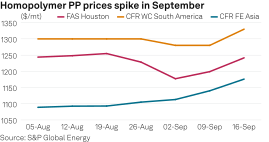
WCSA turns to regional supply
In the West Coast of South America PP market participants have remained focused on regional volumes, as Asian imports have been uncompetitive for several weeks.
Market feedback indicated mixed demand signals amid reduced availability of US-origin PP, while Asian cargoes remained with low buying interest due to rising upstream costs and elevated freight rates, despite a recent decrease.
"Asian prices are sky-high," a trader said.
A producer said that China prices were too high, so they had not closed any recent orders to the WCSA, as buyers are purchasing from regional suppliers at prices reported to be $150-$200/metric ton below China PP.
Pricing levels for US PP homopolymer were heard to be within $1,300-$1,350/mt CFR WCSA, while South American suppliers at $1,350-$1,450/mt and Chinese material mostly above $1,500/mt.
On the other hand, a second trader said sourcing PP from US producers has become more difficult, while offers from the Middle East have been withdrawn, reducing market supply.
A third trader said to be seeing solid demand, as customers are returning from the sidelines to restock, recognizing that the Middle East crisis is not likely to be resolved anytime soon.
Platts Container Rate 29 — North Asia to West Coast South America — was assessed at $6,300/forty-foot equivalent unit on Sept. 18, down $1000 on the week, as spot activity softened amid upcoming seasonal operational slowdowns associated with Golden Week.
Though the container rate fell on the week, prices are still $1000/FEU higher from the beginning of August, according to Platts data.
Despite a couple of sources reporting even lower freight rates—heard as low as $4,500/FEU for October—they do not believe that Chinese PP can easily reenter the Latin American market in the short term, as elevated oil prices and ongoing tensions in the Middle East are likely to persist for some time.
China PP prices at multi-month high
Chinese PP prices surged to a two-month high in the domestic market and a four-month high on export prices, driven by the rise in Brent crude, a subsequent spike in domestic propane costs, coupled with tight supply.
Platts assessed PP raffia FOB China at $1,250/mt on Sept. 18, $115/mt higher from the beginning of Sept, according to Platts data.
However, the rally may be losing momentum.
"Any further surge in prices is unlikely in the near term, as deal volumes have already started to weaken and buyers are beginning to resist higher prices," a China-based analyst said. The analyst added that "coal-to-olefins producers in China are able to offer lower prices," a view echoed by a China-based trader who said "the recent stability in coal prices is likely to allow CTO producers to lower their price offers."
Sellers are also under pressure to move inventory ahead of the Golden Week holiday in October.
"The upcoming Golden Week holiday in October is also prompting sellers to clear their inventories by the end of the month," the trader said, though "stronger domestic selling prices are currently preventing them from cutting export prices aggressively."
Elevated freight costs continued to be the main hurdle for Chinese PP exports, traders said.
