Chemicals, Refined Products, Polymers, Olefins, Naphtha
August 04, 2026
EU imports of Asian PVC surge while market awaits clarity on antidumping case
Editor:
HIGHLIGHTS
Limited supply alternatives if duties imposed
UK to investigate on PVC from China, Mexico, South Korea
More than seven months after Ineos Inovyn said it intended to file an antidumping complaint regarding suspension polyvinyl chloride with the European Commission, no formal investigation has been announced. Yet the issue is returning to focus for PVC market participants as imports from China, South Korea and Taiwan continue to rise despite the prospect of future trade restrictions and as the UK Trade Remedies Authority announced on Aug. 4 an antidumping investigation into imports of PVC from China, Mexico and South Korea.
EU import volumes from Asia have continued to increase since Ineos Inovyn's initial announcement. South Korean shipments to the EU-27 totaled 28,287 metric tons in May, only 185 mt below the all-time high seen in January, and up from 9,793 mt in May 2025, according to the most recent Eurostat trade data. Chinese PVC exports to the EU-27 reached a record 9,651 mt in May, up from 5,788 mt a year earlier, while Taiwanese shipments to the EU-27 totaled 7,918 mt, their third-highest monthly volume and up from 3,907 mt a year earlier.
While market discussions have primarily centered on Asian-origin PVC, Mexico also remains a focus for participants, having shipped 15,733 mt to the EU-27 in May, its largest monthly volume of 2026.
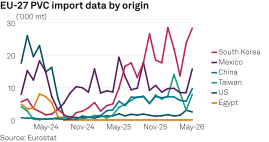
The sustained growth in imports highlights the extent to which suppliers of Asian and Mexican material have become embedded in European supply chains despite ongoing discussions around potential trade protection measures. European producers have continued to cite mounting pressure from imports as consumers increasingly purchase Asian PVC or reference Asian offers during negotiations. Consumers, meanwhile, point to the need for a competitive raw material cost base to remain competitive against imports of finished and semi-finished goods.
While material flows to the EU have increased, this alone does not justify imposing antidumping duties. Under EU trade defense rules, antidumping duties can only be imposed where the European Commission finds that: imports are being sold into the EU at prices below their normal value in the exporting country; the EU industry has suffered material injury; there is a causal link between those imports and the injury; and imposing measures is in the overall interest of the EU.
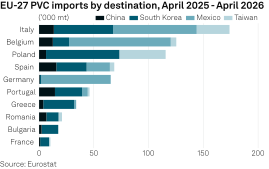
Why the arbitrage exists
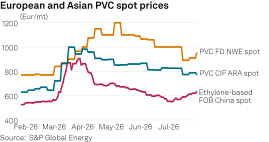
The European PVC market faces some of the highest production costs globally, relying on comparatively expensive ethylene produced largely from older naphtha-fed steam crackers. Higher energy costs, labor expenses and regulatory requirements further erode competitiveness across the value chain. As a result, European PVC prices are typically among the highest globally, leaving the market vulnerable to imports from lower-cost producers.
Europe previously imported PVC mainly from the US and Egypt. However, in January 2025, the European Commission imposed definitive antidumping duties on PVC imports from those two countries. Duties on US material range from 58% to 77%, while Egyptian imports face duties of 74.2% to 100.1%, effectively rendering material from both origins largely uncompetitive.
Meanwhile, an opportunity emerged for producers in South Korea, Taiwan and China, who faced structurally long supply, weak domestic demand, and a more competitive cost base than European producers. The EU-27 also offered stronger netbacks than regional markets, while relatively high PVC prices continued to support the arbitrage. In addition, the European market sees less competition from carbide-based PVC than in many other regions due to limited buyer acceptance.
Limited alternatives if duties imposed
Should antidumping duties be introduced on China, South Korea and Taiwan, replacement volumes could prove difficult to secure given existing duties on imports from the US and Egypt.
Imports from Brazil have emerged periodically, although sellers of Brazilian-origin product describe these flows as opportunistic rather than structural, often arising from temporary inventory imbalances. Brazilian exports to the EU-27 totaled about 2,200 mt in June, according to S&P Global Market Intelligence's Global Trade Atlas, while Brazil itself remains a net import market, importing about 54,000 mt/month, primarily from Colombia and Egypt.
Brazil's own trade measures could also limit its viability. The US was previously a key supplier to Brazil before the Brazilian Chamber of Foreign Commerce raised antidumping duties on US PVC from 8.2% to 43.7% on May 29, 2025. With US material now unattractive in Brazil, there is increased demand for domestic material and, subsequently, less available to export.
Within Asia, countries such as Thailand and Japan have also been discussed. However, market participants noted these exporters typically prioritize regional outlets and have historically had limited export volumes available.
Market participants also point to QatarEnergy's capacity as one potential alternative source, particularly given shorter transit times compared with Northeast Asian origins. However, Eurostat trade data suggests the EU-27 is not currently a primary export destination for the producer.
"There are not really any alternatives to Asia," a European converter said. "If we exclude these origins, the volumes from alternative sources are small, so there would be panic. I don't see other producers or regions which we could treat as regular suppliers."
Impact would vary
While producers argue that antidumping duties are needed to protect European PVC manufacturing from lower-cost imports, converters and distributors warn that higher resin costs could simply shift import pressure further down the value chain to imported finished and semi-finished goods.
"European consumers would be forced to buy from regional producers at the world's highest price," a Chinese trader said.
Some market participants also argued that duties do not address the industry's underlying structural challenges, including comparatively high energy and production costs in Europe. Others noted that, even if imports were reduced, the market could still face oversupply from regional production, suggesting further domestic capacity rationalization may be required. At present, European PVC producers' operating rates stand at about 60%, sources said.
The impact would also vary significantly across exporting regions. Between June 2025 and June 2026, South Korea exported 272,346 mt of PVC to the EU-27, accounting for 35.1% of its total exports. In comparison, the EU-27 accounted for just 2.8% of Chinese exports and 7.6% of Taiwanese exports over the same period, suggesting duties would affect South Korean producers the most.
Any duties could also reshape competition in other import markets as displaced Asian volumes seek alternative outlets. Market participants said this could increase competition in regions such as India, Southeast Asia and Africa, particularly between Chinese and US-origin material.
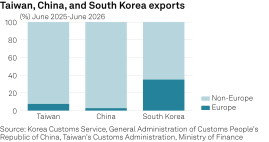
Whether antidumping duties are ultimately introduced or not, the continued increase in Asian imports highlights the central challenge facing the European PVC market: balancing the competitiveness of regional producers with the need for competitively priced feedstock for downstream consumers.
The European Commission's Office of Complaints and Ineos Inovyn did not immediately respond to requests for comment.
