Chemicals, Polymers
November 13, 2025
Ineos antidumping move divides European PVC market
By Joe Higginson, Zhi yi Tan, and Iris Poon
HIGHLIGHTS
Italy and Poland import greatest volumes from Asia
Traders eye Qatar and Thailand as potential alternative sources
Polyvinyl chloride market players had mixed responses to the news on Nov. 11 that Ineos had filed, or was in the process of filing, anti-dumping cases with the European Commission for 10 strategic products, including PVC.
European producers welcomed the news but questioned whether a response would be prompt enough to protect them. Traders debated the case for ADDs and considered alternative supply options, while consumers expressed concerns over margins in the absence of competitively priced imports.
In the second half of 2025, Europe experienced a surge in imports from Asia, particularly from South Korea, China, and Taiwan. South Korea has led the charge so far, peaking at 17,588 metric tons in July. Meanwhile, China and Taiwan also recorded gains, with the EU importing 6,987 mt and 7,163 mt, respectively, in August.
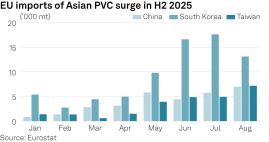
The increase in imports from Asia follows the EU's implementation of definitive antidumping duties on US- and Egypt-origin PVC in January. Antidumping duties range from 74.2% to 100.1% for imports from Egypt and 58% to 77% for imports from the US. As a result, imports from both regions have become largely uncompetitive. At the same time, Asian producers have sought overseas outlets amid weak domestic demand, greater netbacks in export markets, and favorable freight economics to Europe.
Following the rise in imports from Asia, European producers have increasingly called for protectionist measures, citing challenging margins at current price levels. By region, Southern Europe has seen the greatest import pressure, with Italy receiving a total of 35,550 mt of imports from South Korea, China, and Taiwan in 2025; Poland has also received notable volumes.

Pressure on producer margins has been evident this year through the announcement of numerous capacity rationalizations. Most recently, Vynova ceased PVC production at its Beek plant in the Netherlands on Nov. 8. The Beek plant has an annual PVC capacity of 225,000 mt/year, according to S&P Global Energy data.
"Any support is important. We are suffering from low margins; life is difficult," a Europe-based producer said.
A second Europe-based producer said, "Europe has not been competitive, with high sustainability costs and energy prices, producers’ hands are tied. It is about survival and protecting thousands of jobs. We need antidumping duties urgently, not in two to three years’ time," they added.
Meanwhile, European PVC consumers have sought competitively priced imported materials amid difficult conditions in downstream sectors, reflecting a weak European construction market and pressure from Asian imports of low-cost finished and semi-finished goods.
"Customers are extremely opportunistic," the first Europe-based producer said.
While most European producers maintain that dumping is occurring and that a case exists, traders have said there could be insufficient historical data to prove dumping, and that price differentials between domestic and export markets do not constitute dumping.
If ADDs were implemented on Asian-origin material, traders expect they would be less likely to apply to imports from Taiwan compared with South Korea and China, potentially leaving a continued arbitrage open from Taiwan. Elsewhere, traders said material could be redirected from Thailand into the EU, as well as from Qatar, once new capacity comes online. However, traders were keen to note that little has changed at present.
"Nothing has changed for now, and we still have other supply options," a Europe-based trader said.
Across the water, feedback in Asia has also varied from player to player. Some Asian producers and traders expressed concerns that ADDs could negatively impact their markets, where it could render them uncompetitive. As one China-based trader highlighted, "The pressure may increase, as Europe is a market where exports are growing year by year." On the other hand, some players said export volumes to Europe remain relatively small, questioning the overall impact of such measures. "The trade volume is not significant compared to domestic production; I believe there will be some effects, but they are unlikely to be substantial," another China-based trader said.
Players across the board kept a close eye on any further updates regarding an antidumping duty investigation on Asian-origin PVC, as uncertainty persisted. Meanwhile, the European PVC market continued to face low demand and ample supply, with limited expectations of a recovery into the year-end.
Platts, part of Energy, last assessed the FD Northwest Europe PVC spot at Eur810/mt Nov. 12, down Eur5/mt week over week.

Editor: