Chemicals, Polymers
July 24, 2026
Americas' polyethylene prices rise, reversing downward trend on shifting sentiment
Editor:
HIGHLIGHTS
All but two PE grades are stable to up on latest Platts assessment
Middle East conflict heightens demand, pushing sentiment upwards
Weak downstream dynamics and fears of demand destruction remain
Polyethylene prices in the Americas appeared to stabilize or rise,as all but two of the grades assessed by Platts in the region held steady or increased during the week ended July 22.
This overall upward movement broke with the downwards trend that had taken hold of all regional markets since the end of April, when record pricing levels, fostered by panic buying amid the uncertainty from the Middle East conflict, led to demand destruction across the global petrochemical sector.
Platts, part of S&P Global Energy, assessed all PE grades basis FAS Houston, delivered Mexico and CFR West Coast South America up $10-$88/metric ton from July 15-22. All delivered Argentina prices remained stable over the same period, while most prices basis CFR Mercosur went up $30-$60/mt, and most CFR Brazil levels remained stable. The only drops were seen on low-density PE prices in Brazil and Mercosur, at $25/mt and $45/mt, respectively.
| Platts PE price change from July 15-22, by market and grade | ||||||
| Grade | FAS Houston | DAP Mexico | CFR Brazil | CFR Mercosur | CFR WCSA | DAP Argentina |
| HDPE film | up +$66/mt | up +$30/mt | stable | up +$45/mt | up +$70/mt | stable |
| HDPE blow molding | up +$33/mt | up +$30/mt | stable | up +$30/mt | up +$70/mt | stable |
| HDPE injection | up +$66/mt | up +$30/mt | stable | up +$30/mt | up +$65/mt | stable |
| LLDPE butene | up +$88/mt | up +$10/mt | stable | up +$60/mt | up +$10/mt | stable |
| LDPE | up +$11/mt | up +$10/mt | down -$25/mt | down -$45/mt | up +$50/mt | stable |
Though US PE prices began trending upward since the first full week of July, most of the grades and markets on the rest of Latin America lagged behind, still under pressure of aggressive offer levels from both importers and regional producers.
The trend change in Latin America, according to sources, was tightly tied to renewed tensions in the Middle East, once again spreading concerns of petrochemical supply crunches and higher upstream costs.
"Customers are worried that prices will rise, with the rumors about the Iran war," a Brazil-based trader said. "I believe that sales will start to occur more often in August, as prices won't be down again."
Latin American prices have also received support from increased attempts by US producers. Exports out of North America are usually the most competitively priced ones in markets like Mexico, Brazil, Colombia and Argentina.
However, US producers have recently gotten emboldened to post higher offers, with stronger interest in US-origin PE emerging from various regions. Though accounts differ across market participants, this heightened worldwide demand has spread a sense of US availability constraints.
"My suppliers have increased between 3-5 cents/pound," a US-based trader said. "Most of the July allocation is sold out, and left over is not big now." A distributor in the country disagreed. "I don't think supply is limited. I think the suppliers want us to think that by holding product, they can continue to push for price increases."
Some participants in Latin America have also seen converters' inventories dwindling.
According to a trader involved in West Coast South America, several customers needed to buy soon. Although they could have purchased a couple of months ago, the trader emphasized, those who wanted to wait longer for lower prices will now have to accept higher ones.
A third trader echoed the sentiment, noting that "momentum has changed."
Challenges to the trend change
Nevertheless, specific market dynamics in Latin America could hinder the upward pricing trend in the following weeks.
Across all markets assessed by Platts, downstream demand remained weak, and some participants feared higher prices coming from the US, and uncertainty around the Middle East conflict might not be sufficient to reactivate purchase appetite and might even trigger a new wave of demand destruction.
"Those who buy today are the ones who fear higher prices next month," a distributor based in Paraguay said. "But some are still closing at similar levels to the first half of the month, and that means buying appetite is not strong. If prices from the US keep rising, no one will buy."
Things have been similar in Argentina, where a distributor source said local demand was very weak, with ample offers and material available in the market. And in Brazil, besides a faint purchasing appetite, customers were also fearing that the antidumping duty on US imports, currently at $199.04/mt, could be increased, drying up interest in purchasing North American material.
Brazil's foreign trade committee will hold an ordinary meeting on July 30, during which requests to reconsider the effective tax rate could be evaluated. Market participants noted that domestic producer Braskem was pressing for the antidumping duty to be increased to closer to $700/mt, following a technical analysis of dumping margins.
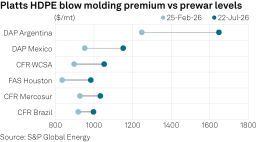
Even if prices stabilize and reach an equilibrium at current levels, the situation for PE sellers looks significantly better than before the start of the US-Iran war. Over the first two months of 2026, several supply-side market participants lamented low prices, noting that margins were unsustainable for their businesses.
After the war began on Feb. 28, most market participants expected that elevated prices would eventually decline, though many hoped they would stay above late-February levels. That outlook has proven accurate, as pricing across all Americas markets and PE grades remains above the levels recorded on Feb. 25, the last assessment before the conflict started, according to Platts data.