Chemicals, Polymers, Aromatics
June 30, 2026
H2 OUTLOOK: Demand destruction to keep shaping global chemicals for rest of year
Editor:
HIGHLIGHTS
Producers try to carve out wider margins
Panic-buying leads to inflated downstream inventories
Price volatility expected through end of year
The global chemical industry faces a shared challenge of demand destruction heading into the second half of 2026, despite regional differences in severity and timing across the Americas, Europe and Asia.
War-driven disruptions earlier in the year led to panic-buying at high prices and inflated inventories, according to market participants, but as downstream consumption failed to absorb the high-priced supply, markets began to retreat from those historic highs.
In addition to persistently weak demand, market participants are also grappling with cautious outlooks and uncertainty about when those elevated prices will finally subside.
"In the second half of 2026, the market should move from disruption toward stabilization as Middle East exports resume," said Jesse Tijerina, executive director and head of global polymers at S&P Global Energy CERA. "Consumers will expect prices to continue their downward trajectory and look to increase production and to rebuild inventories after aggressive destocking, yet they are likely to do so cautiously, as pricing uncertainty remains elevated."
Margin recovery efforts backfire
The supply shock stemming from the closure of the Strait of Hormuz prompted producers worldwide to improve the record low margins reached in 2025. Though they found some success from March to mid-April, higher prices have largely failed to gain traction; instead, accelerated demand destruction.
In the Americas, high-density PE blow molding grade prices jumped to $1,764/metric ton FAS Houston on April 16 from $838/mt on Feb. 25. Prices have since fallen sharply to $1,047/mt FAS on June 24, according to Platts, part of S&P Global Energy, data. The trend has been similar across regions and commodity sectors.
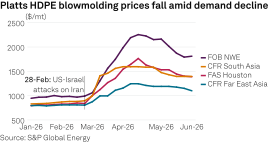
The downward price move was supported by "strong resistance from customers," according to a US-based distributor, who expected the trend to continue "definitely and more accelerated." PVC followed a similar trajectory, peaking at $1,050/mt FAS Houston April 8 before declining to $690/mt June 24, and sources were unsure if this was the bottom of the cycle.
When prices rise faster than downstream economics can support, buyers respond by reducing run rates, delaying purchases or suspending activity entirely, a dynamic seen across Asia, where difficulties in passing higher costs to end-users have prompted producers to reduce operating rates.
Indian producers, however, might have an easier time chasing better margins due to some legislative advantages.
"The possible reintroduction of 8.5% customs duty from July, and a push to reintroduce quality controls on imports, would drive prices going ahead," a producer said. "That would be helpful for us in increasing the local prices."
Weak end-consumer demand weighs on recovery
A faint buying appetite has emerged as the primary obstacle to market stabilization across regions.
In the Americas, polymer markets such as PP, PE and PVC face weakness as buyers struggle to pass higher costs to downstream sectors, a challenge intensified by elevated inventory levels.
"Buyers are now seeing who will blink first," a PVC producer said.
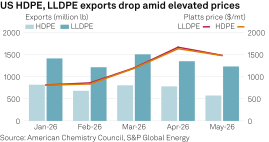
Europeans and Indian companies are adopting a cautious approach over the rest of 2026. In Europe, smaller converters are prioritizing affordability over volume to avoid higher-priced inventory. In India, tight working capital and earlier high prices are dimming hopes of restocking ahead of the September-October festival period and December export demand.
In Asia, seasonality is also weighing on recovery, with buying activity dipping in May as converters reduced operating rates and cut PE resin procurement. China's PVC outlook remains especially fragile.
"If we look solely at the industry itself, the situation is rather bleak," a Chinese trader said.
Price volatility to define H2
As demand destruction limits buyers' ability to absorb higher prices, pricing uncertainty is expected to remain a key challenge in the second half of the year.
In Europe, volatility is likely to be driven by the tension between sellers' margin recovery efforts and buyers' affordability limits, with markets such as PS and PET likely to remain exposed.
American PE participants not only worry about a "structurally oversupplied environment," but also about pressures from geopolitics, Chinese exports, freight, new capacity, energy and feedstock swings, and hurricane risks. All of those bring uncertainty to prices.
Supply-side issues will also be at the forefront for Asian and Indian participants, mainly linked to feedstock volatility. Benzene and paraxylene are among the Asian markets most exposed following sharp price movements in the first half of 2026, with benzene prices in particular expected to soften over the next six months as crude and naphtha values decline.
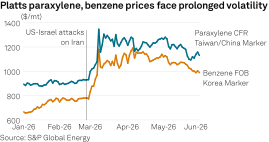
"Apart from PX volatility, the ups and downs in freight rates from various origins would be an important challenge to keep a lookout for," a buyer said.
According to a PP buyer, risk surcharges and congestion-led high freight rates "would impact pricing going ahead."
With demand destruction driven by weak end-user absorption and high inventories -- and producers' margin recovery repeatedly undermined by buyers' affordability limits and cautious purchasing behavior -- the global chemical market is bracing for continued downside pressure and volatility through year-end.
