Chemicals
July 13, 2026
H2 OUTLOOK: Shipping bottlenecks, uncertainty to impact Middle East chemical trade
Editor:
HIGHLIGHTS
Concerns drive Middle East supply shifts
Shipping bottlenecks keep chemical costs high
China emerges as key regional swing supplier
Petrochemical supply flows from the Middle East over the second half of the year are contingent on shipping bottlenecks, many of which will depend on how the conflict between the US and Iran develops. But, market participants said, it's unlikely there will be swift return to prewar trade flow levels for most chemicals originating in the Middle East, as the economics of global trade have changed.
While it is likely that there could be a rise in supply options as the passage through the Strait of Hormuz remains open, longer period of delivery uncertainties may keep supply options from the Middle East unattractive, market participants said. Also, Indian importers are still seeking clarity from their banks on buying from Iran, a trade source said.
"There have been reports about damage to facilities in the region," a buy-side market participant based in India said. "The likely disruption in output is unknown."
The financial cost of damage is likely to be borne by the sellers and the buyers for a few months, the buyer said.
Separately, whether China-origin exports -- of methanol, polypropylene and polyethylene, among others that filled the gap amid the conflict -- remain attractive in terms of prices and delivery timelines over the second half would be an important factor to watch, market participants said.
China steps up amid the void
China has pivoted from its traditional role as a net importer to a regional swing supplier, especially for styrene and methanol. This dynamic is expected to persist through H2 2026, though depleting coastal stocks may eventually constrain the volume of spot cargoes available for export.
Chinese market participants remain broadly unconcerned about imported supply, according to China-based end-users and traders, even as coastal inventories continue to decline, well below the typical 900,000-1.1 million metric ton range. Inland production is compensating, with domestic methanol operating rates having risen sharply since the start of the conflict. Regular trade flows from Trinidad and Tobago, Southeast Asia, Chile, Russia, Oman and Venezuela should keep China's supply fundamentals finely balanced in the absence of Iranian methanol, which makes up around 50% of China's total annual methanol imports, methanol buyers and traders said.
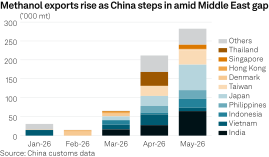
Taiwan faces the greatest vulnerability among Northeast Asian buyers. Taiwan sources a significant share of its methanol from Saudi Arabia under term contracts, leaving it structurally short in the current environment. Re-exports from mainland China have provided partial relief but have not been sufficient to fully offset the loss of Middle Eastern non-sanctioned supply.
Southeast Asia is comparatively less exposed, with Saudi Arabian molecules accounting for about 10% of total regional methanol demand. While the market faces additional upside risk from planned turnarounds and unplanned outages across the region, Chinese export cargoes are expected to partially cap the upside.
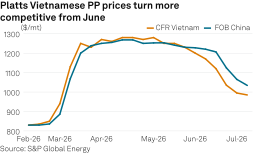
In the polymer space, China became a major new exporter of polypropylene because of rapid capacity expansion and slower domestic demand growth.
A key part of this shift could be attributed to China's feedstock strategy. Faced with volatile naphtha and imported feedstock availability, China expanded coal-to-olefins run rates. Run rates reached as high as 100% for some CTO producers, market participants said. CTO producers also benefited from lower costs compared with crackers and propane dehydrogenation plants.
China's export competitiveness, however, is now being tested. Vietnam has emerged as one of the most competitive PP suppliers in Asia, with feedstock levels restored in the region. Weaker consumer demand for PP finished goods also led to excess supply in Southeast Asia, which pushed down export prices in Vietnam.
Shipping bottlenecks
The closure of the Strait of Hormuz pushed producers to transport material to operational ports in other parts of the region, market participants said.
"High road freight only added to the cost of the material, large volumes of which were under contracts and got canceled due to long sailing time," another sell-side source based in the Middle East said.
While there is an expectation that a large volume of material, already accumulated at the ports, could be sold as distressed cargo, market participants expect shipping companies to continue to charge risk surcharges amid prolonged uncertainty over the truce. This could keep the prices of chemicals originating in the Middle East high for a considerable period in the second half, prompting buyers to look to other origins for imports, they said.
Separately, non-sanctioned shipowners have been refraining from carrying Iranian-origin cargoes due to fears of sanctions or payments getting stuck, a trade source said.
For polymer producers, one concern is liquidating stocks that have built up at alternative ports in the Middle East during the closure of the Strait of Hormuz.
"Producers paid extra road freight to transport material to operative ports during the war," the first sell-side source said. "Liquidating them from those alternative ports, from where sailing time is longer, is an added concern."
Market participants said even if the Strait of Hormuz remains open and US-Iran-Israel hostilities subside, traders estimate it would take three months for shipping to normalize, and oil products would take priority over chemicals in any resumption of flows.
With the latest flare-up in tensions between the US and Iran, the closure of the Strait of Hormuz is back in focus, and concern over delays in shipment, prioritizing crude oil and essentials for passage through Hormuz and persistence of higher feedstock costs are likely to be among the factors that market participants will closely watch in the second half of 2026.
