Chemicals, Polymers
July 10, 2026
Global PVC prices ease back toward prewar levels as buyers remain cautious
Editor:
HIGHLIGHTS
Buyers delay purchases, expecting further drops
New geopolitical tensions add market uncertainty in July
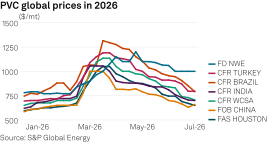
After record-high polyvinyl chloride prices in April that impacted demand, global prices in July are returning to pre-Middle East war levels. Amid reports of high inventories, market participants say there is no clarity on the "bottom" of this downcycle, as new geopolitical conflicts added further uncertainty, market participants said.
The return of prices to prewar levels happened earlier than the market expected. With continuous decreases in export offers from major producers in the US and China, buyers have been pressuring negotiations with progressively lower bids.
Platts, part of S&P Global Energy, assessed US PVC prices at $650/mt FAS Houston on July 8, down sharply from the $1,050/mt peak in April, and on par with the Feb. 25 assessment before the war began.
Buyers, meanwhile, have been seeking smaller volume offers for August, expecting prices to keep falling. "Nobody is asking for July shipment anymore," a US-based trader said. "Buyers [would] rather take August shipment at a lower price."
In Latin America, whose main supplier is the US, traders said many of their clients bought volumes equivalent to three months of inventory between March and April. As a result, expectations were that there would be some demand recovery in July, but that recovery proved much slower than anticipated.
In China, Platts assessed FOB China ethylene-based PVC at $650/mt and carbide-based PVC at $660/mt on July 9, nearly matching prewar assessments of $650/mt and $625/mt, respectively, on Feb. 27.
Adding to the challenging export market, China eliminated its 13% VAT rebate for PVC exports effective April 1, raising costs for exporters.
The Asian market continues to struggle with lackluster demand and persistent oversupply, while prices move toward prewar levels. Among China's import markets, traders in India said they are unable to gauge the market bottom. "The bottom before prewar was $600/mt, but now we cannot say what the price floor is," a local trader said.
New attacks increase uncertainty
While looking for clearer signals on when demand might resume more consistently, market participants faced further uncertainty after renewed US-Iran attacks in the first half of July.
A second US-based trader said the new uncertainties further weighed on buying sentiment. "The news about the war concerns some people now."
In Asia, exporters pursued aggressive pricing to capture market share. However, with the Middle East conflict escalating again, some sources indicated these lower prices are no longer available. "Issues in the Strait of Hormuz have emerged, and offers have increased again," a Chinese trader said.
Market sentiment remains cautious about the uptick following the re-escalation of the Middle East conflict, with concerns about whether demand can keep pace. "Heard that other Northeast Asian and Southeast Asian origins are being offered at better prices to the Indian market. If China raises prices, we'll lose even more competitiveness," a second China-based trader said.
A second India-based trader said the lack of clarity around offer availability also makes it harder to read the market. "FOB China is at prewar levels, considering the reinstatement of the VAT rebate; however, China has not offered in 15 days, and whenever it comes into the market, it can beat any price," said another India-based trader.
Regional peculiarities
Beyond global geopolitical uncertainty, regional factors have also been shaping demand. In the US, while domestic sales have shown an expected increase for the season, demand from Latin American buyers has been uneven. In Colombia and Peru, for example, multiple buyers said political uncertainties have affected purchasing interest in recent months.
In turn, in Asia, while exports remain challenging, domestic consumption is also weak, and factories are building inventories amid unfavorable market conditions, another local trader said.
In South Korea, a producer said that "intra-Asia demand is still limited, but better than in overseas markets, as the shorter transit time of Asian cargoes helps reduce buyers' risk."
Market sources also said prices are falling due to weak demand in India and the monsoon season in Southeast Asia.
"Our market in the Middle East will decrease because Qatar is back to manufacturing while China's demand has remained subdued for some time, so material is being diverted to Southeast Asia and India," a Chinese producer said. The same source said that as Chinese material moves into Southeast Asia, manufacturers there are pushing more volume into India.
An India-based producer said that a shortage of volumes in India's trading market is allowing domestic producers to keep prices stable. With import duties reinstated, those prices would be above $800/mt on an import-parity basis. However, an Indian trader said the supply shortage may be temporary, as producers across Asia are trying to divert material into India.
