Chemicals, Refined Products, Aromatics, Solvents & Intermediates
July 08, 2026
H2 OUTLOOK: Europe’s chemical industry enters second half of year with caution
Editor:
HIGHLIGHTS
Weak demand remains persistent challenge
Benzene shifts to gasoline amid tight margins
Recycled polymers struggle despite regulations
After a volatile first half of 2026, Europe's chemical industry is entering the second half in a state of guarded stability rather than recovery. The core challenge remains demand. Consumption tied to essential sectors such as food packaging, healthcare and some consumer staples has held up, but construction, manufacturing and parts of the automotive chain remain subdued.
The region's structural cost disadvantage, as well as concerns over logistics disruptions and any costly solutions to them, have added to the already defensive approach.
Gasoline vs. chemical markets
European steam crackers have shifted to more LPG as feedstock where possible due to a wider naphtha-propane spread. The monthly average Platts-assessed CIF NWE naphtha spread to CIF NWE was at $139.63/mt in June, and through July 8 the average widened to $144.19/mt.
This has tightened the benzene market as LPG feedstocks yield less benzene than naphtha. At the same time, elevated gasoline values encouraged blending of derivatives, pulling material away from chemical applications. The Platts Eurobob crack vs. Brent was at $32.15/b July 8, up sharply from $10.14/b before the Middle East war started in late February. The pull from the gasoline pool has also had an impact on styrene production margins as spot benzene climbed over styrene in June. CIF ARA benzene was assessed June 29 at $1,120.25/mt and FOB ARA styrene was assessed at $1,041/mt putting benzene at a $79.25/mt premium to styrene. The spread has since flipped, and styrene was back to a premium to benzene at $122.50/mt July 8, but the volatility has made styrene makers cautious on production.
A similar story applies to the xylene chain, as lackluster demand for chemical applications continued after earlier PET resin panic-buying in March. Platts assessed the July MX CIF ARA premium to FOB ARA Eurobob gasoline at $220.25/mt July 3, nearing a two-year high and reflecting solid economic incentives for routing mixed xylenes into gasoline blending pools rather than chemical end-uses.
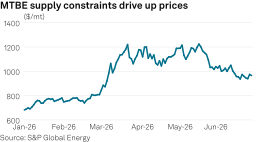
But even higher gasoline prices have not been enough to lift all the chemicals used in gasoline blending. Crude and gasoline prices lifted outright MTBE values, but subdued demand and ample supply limited the impact on bullish pricing movements. Through June, MTBE prices remain above March but have backtracked from record highs in April and May.
Demand uncertainty is even more pronounced for chemicals that do not compete directly with fuels for feedstocks, particularly in the face of prior rationalization efforts.
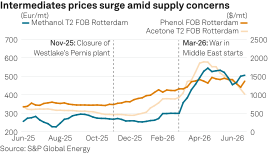
Intermediates such as phenol and acetone entered 2026 still absorbing the impact of earlier downstream closures, including Westlake's 150,000 mt/year bisphenol-A plant at Pernis, Netherlands, and Trinseo's 100,000 mt/year MMA facility at Rho, Italy. The loss of Westlake and Trinseo's assets has reshaped regional balances, which were then further disrupted following the war in the Middle East.
Through July, European intermediates producers were still navigating a difficult operating environment. The decision in late June to push the restart of Ineos' Antwerp facility beyond 2027 has added to the uncertainty around Europe's phenol and acetone supply outlook.
And although the EU's Packaging and Packaging Waste Regulation is expected to become a key reference point for the sector, market participants remain divided over whether Europe has enough collection, sorting, mechanical recycling and chemical recycling capacity to meet future needs, particularly after closures and delays to recycling assets during the first half of 2026.
Pessimism for remainder of year
As a result, the broader H2 outlook is cautious and conditional. A stronger manufacturing base could increase demand for polymers, intermediates and aromatics, but without a robust economic recovery, the market will remain driven by cost control, import competition, regulation and changing downstream focus, where possible.
Producers are expected to keep output closely aligned with confirmed demand, while buyers are likely to maintain lean inventories.
The Middle East war delivered a reprieve for European producers, with price spikes lifting margins across parts of the petrochemical chain. However, the core pressures driving consolidation in key markets remain firmly entrenched: elevated input costs, weak naphtha cracking economics, competitive import flows and persistent oversupply. The chemicals market is moving back toward the prewar operating environment, where structural cost disadvantages and excess capacity dominate producer decisions.
Europe's petrochemical industry has become more adaptable after several years of disruption, but adaptability has not restored confidence. Until demand strengthens, energy and freight risks ease, and geopolitical tensions become less disruptive, the second half of 2026 is likely to remain a period of careful navigation rather than clear recovery.
