Chemicals, Polymers, Aromatics
July 07, 2026
H2 OUTLOOK: US PE, styrene exports at risk; benzene, PET inflows to continue
Editor:
HIGHLIGHTS
US loses chemical export share to Asia
Imports continue despite tariff barriers
Trade position faces structural challenges
The US petrochemical industry faces a challenging second half of the year as it continues to lose market share in key sectors like polyethylene and styrene and at the same time increases its import dependency on benzene and polyethylene terephthalate despite import tariffs intended to curb those imports.
The low feedstock costs that had sustained US exports have become less of a factor as Asia offers more competitive prices. US exports face additional challenges, including higher shipping costs that have closed arbitrage opportunities. US producers also have to contend with imports as Asian PET makers retain a pricing advantage even after supply disruptions overseas.
US struggles to position exports
After the March global supply shock, the US briefly became the world's de facto chemical supplier, as most US production is detached from value chains overseas that the Middle East war disrupted.
The US, once the source of 70% of imported polyethylene into Brazil, had a market share of only 17% in May, according to Brazil's Ministry of Development, Industry, Trade and Services.
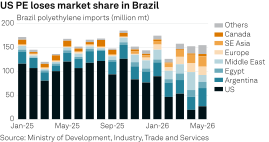
US PE lost competitiveness in Brazil after Brasilia implemented import tariffs on Aug. 29, 2025. The US also became less competitive in the West Coast South America region after the US increased prices in March and April. This opened the door to imports from China that were $300/mt lower than US product.
By mid-April, Platts, part of S&P Global Energy, assessed US high-density PE film at its year-to-date peak of $1,797/mt FAS Houston, more than $860/mt above end-February levels. In comparison, HDPE film CFR Far East Asia prices never rose over $480/mt from prewar levels.
As the impact of the Middle East war on global trade slowly normalizes, US PE exports have remained unworkable. At the end of May, the lowest offer indication of China-origin HDPE film to WCSA was at $1,470/mt CFR, $100/mt below the most competitive US-origin offer, a trader source said.
Some participants see the attractiveness of Chinese product as temporary, saying that shorter transit times and brand recognition will ensure US material regains market share, but prices have yet to bear that out.
"I have been selling more product from China than from the US, but now freight is becoming complicated," a Brazil-based trader said.
US exports are facing other structural problems exemplified by the styrene trade. The USGC to Amsterdam-Rotterdam-Antwerp route is key for styrene exports, but prices overseas have fallen on ongoing US-Iran peace negotiations and lower crude prices. This closed the arbitrage window from the US to the benefit of Europe's domestic suppliers.
"In styrene, the trade challenge is very pronounced," said Roger Roettger, principal analyst of olefins and polymers at S&P Global Energy CERA. "The US needs better cost positioning or risks vulnerability when overseas can supply at lower costs."
Platts assessed FOB USGC styrene prices at 48.53 cents/lb July 6, compared with $1,186/mt FOB ARA, or 53.8 cents/lb. Considering transportation costs are just over 4 cents/lb, the spread is not wide enough to support the US-NWE arbitrage.
Imports into US continue despite barriers
The US remains a large chemical importer, despite legislative efforts and market disruptions caused by the Middle East war.
Recent energy volatility pushed USGC benzene prices higher than those in Europe and South Korea. The spread versus Europe was $320.01/mt April 13, and the spread versus South Korea was $360.68/mt. The spread has since narrowed to Europe, but it is still well over the South Korean price.
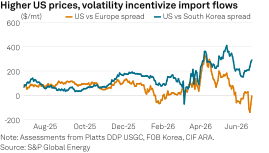
"Strong domestic gasoline values and elevated octane assessments for summer 2026 pushed US benzene prices," CERA analyst Sahar Qavi said. "Recent imports and weaker crude prices have provided some relief, but volatility remains the base-case scenario."
Tariffs have also impacted the benzene market. US imports for Chapter 27 benzene, not subject to tariffs, have risen 244% from March 2025 to March 2026. But Chapter 29 benzene imports, subject to tariffs, have dropped by 50%, according to US International Trade Commission data.
The US has also resumed importing Asian PET after the war had disrupted imports in March and April. But by May, participants said, the US PET supply mix was returning to prior levels of Asian material availability. In fact, few expect significant changes in the supply structure, since Asia retains pricing advantages.
"It is unlikely the US stops depending on PET imports," CERA analyst Roger Roettger said. "It needs them to balance supply, considering recent rationalization. To reduce dependence, it needs both policy support and private investment."
Pricing volatility, continued uncertainty from the Middle East and supply-demand equilibrium will remain points of focus over the latter half of 2026. But if the US wants to solidify a position as a bigger exporter and a smaller importer of chemicals, participants may want to refine their focus on long-term results instead of short-term responses.
"By the end of the year, I expect US import flows to remain below the pre-disruption trajectory, and its export position should remain advantaged where it has a clear cost edge," Jesse Tijerina, global head analyst of polymers for CERA, said. "But it will face stronger challenges whenever Asian capacity is long and freight normalizes."
