Chemicals, Polymers, Solvents & Intermediates
June 30, 2026
H2 OUTLOOK: Construction slowdown threatens H2 2026 petrochemical demand
Editor:
HIGHLIGHTS
US homebuilder index remains under year-ago levels
PVC prices fall on weak demand, oversupply
El Niño weather threatens India's construction
Weak construction activity across global markets is expected to dampen demand for petrochemicals in the second half of 2026, with the potential impact of El Niño threatening to compound sector headwinds.
In the US, homebuilder confidence has remained weak through the first half of 2026, according to the National Association of Home Builders/Wells Fargo Housing Market Index. The index, which measures single-family home builder sentiment, stood at 35 points in June 2026, down from 37 in May and well below the threshold of 50 that indicates positive sentiment.
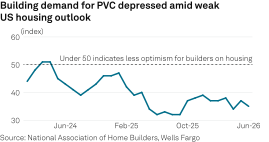
US home goods retailers are also flagging a mixed outlook. Lowe's CFO Brandon Sink said during their first quarter 2026 earnings call on May 20 to expect some of the prior year's tariff and inflation "noise" to moderate, but noted ongoing input-cost challenges.
Construction sector demand remains weak in some markets due to rising material prices and unfavorable weather. In India, traders who bought large volumes of PVC from China, anticipating shortages, have been hit by demand destruction, and lower-cost carbide-based PVC has gained market share, pressuring ethylene-based PVC producers to cut prices.
Also, the monsoon season is beginning, and a large decline in India's import volumes is expected.
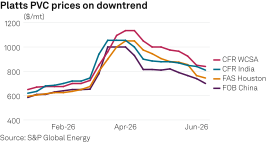
PVC demand in 2026 was already expected to weaken from 2025, and by mid-June, prices had retraced the full increase linked to the Middle East conflict, driven in part by upstream declines. Furthermore, housing slowdowns and higher financing costs point to lower construction growth.
Falling vinyl prices and growing China volumes are generating questions on how far prices can drop while still maintaining profitability. According to S&P Global Energy CERA data, Americas margins are expected to improve year over year, but overall global margins will remain similar to 2025.
High interest rates also continue to dampen prospects in multiple housing markets, with stagnant PVC demand across Brazil and West Coast South America. Demand from the agricultural sector, however, is expected to outpace construction as the main driver of consumption.
Recovery hinges on government action
"In China, housing sales and prices in high-tier cities see initial signs of stabilization, but that will take time to spread to lower-tier cities and pass through to investment activities," said Xu Yating, principal China economist at S&P Global Market Intelligence.
"Infrastructure investment weakened in the second quarter as fiscal spending temporarily moderated amid strong external demand. But we still expect infrastructure to pick up in the second half when employment pressure and investment weakness materially threaten growth," Xu Yating said.
"For domestic real estate and PVC demand in H2 2026, it really depends on whether the government steps in to support the market. Looking purely at the industry fundamentals, it is quite poor," a Chinese trader said.
European construction data has shown signs of improving activity, according to Eurostat. Production in construction has been stable to marginally improved and building permits have shown more substantial gains but remain below early 2025 levels.
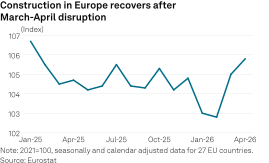
An increase in building permits could signal a future rise in construction activity and demand for PVC, with a lag between permit issuance and construction starting. Among market participants, there is hope that the German government's pledge in 2025 to invest Euro 300 billion into federal infrastructure over the next 12 years could improve regional PVC demand.
Despite these factors, the PVC market remains largely bearish. Oversupply will likely persist unless there is further rationalization in Europe. Market participants are also keeping a close eye on developments at Vynova following news that it had entered administration and insolvency at multiple sites and was now looking for potential buyers.
Unpredictable weather may disrupt India demand
India's construction sector typically slows during the second half of the year due to monsoon rains. However, the India Meteorological Department's first-stage forecast suggests that India's 2026 southwest monsoon seasonal rainfall, covering June to September, is expected to be below normal and deficient.
This presents a double-edged sword: reduced rainfall may benefit construction by minimizing weather-related delays, yet it could also pressure agrarian incomes and contribute to inflation, potentially dampening housebuilding and repainting demand.
"Inflation will outweigh any weather-related benefits for the construction sector," a paint producer said. "Painting is not a basic necessity," the producer added.
El Niño conditions are also a major risk factor for chlor-alkali markets.
"What makes a super El Niño potentially treacherous for chlor-alkali markets is not the disruption itself, but its sequencing," said Alvin Ang, director of inorganics and vinyls in Asia at S&P Global Energy.
"The weather first strikes, with droughts and fires choking alumina and pulp and paper, crushing caustic soda demand," Ang said. "Then comes reconstruction, pulling chlorine and PVC demand upward, even as caustic remains stranded. Asymmetry disrupts markets, and here the coproduct chain delivers it in full. The real question isn't whether volatility arrives, it's whether the industry is positioned when it does."
