Chemicals, NGLs, Refined Products, Olefins, LPG
June 29, 2026
H2 OUTLOOK: War disruptions reshape olefin trade, but weak demand to cap flows
Editor:
HIGHLIGHTS
China exports surge, but H2 demand weakens
US ethane, propane fill Middle East gap
Sentiment cautious for second half of year
The global olefin trade is shifting as US export momentum to Europe and Asia eases. European cracker restarts and weak demand are narrowing arbitrage options, while Middle East war disruptions redirect ethylene, propylene and feedstock supply toward China-led regional trade, reinforcing cautious sentiment for the second half of 2026.
In the US ethylene market, exports to Europe surged after the outbreak of the war amid regional cracker outages. Exports to Europe jumped from 42% of the total global share to 89.8% from February to March, according to S&P Global Commodities at Sea data.
Though ethylene flows from the US are anticipated to continue into Europe in the second half of the year, market participants expect a reduction of volumes as lengthening supply in Europe from cracker restarts and seasonally weak downstream demand reduce the need for ethylene.
While propylene saw several US cargoes arrive in Europe in March and April, as with ethylene, overall import flows will remain limited as the European market softens, closing arbitrage opportunities.
Though US ethylene prices remained competitive, supported by high inventories and strong margins from lower-cost ethane, market participants said export demand was constrained by buyers' reluctance to commit to long delivery timelines amid ongoing global uncertainty.
Instead, trade flows in Asia have shifted, with China becoming a key exporter to South Korea and across Southeast Asia amid a severe shortage of ethylene and propylene from the Middle East.
| Top 10 importers of China propylene in May (mt) | |
| Country | Quantity (mt) |
| South Korea | 37,221 |
| Taiwan | 9,039 |
| Singapore | 2,286 |
| Indonesia | 2,050 |
| Japan | 1,558 |
| United States | 23 |
| Greece | 23 |
| Spain | 22 |
| Saudi Arabia | 18 |
Typically an ethylene and propylene importer, China exported 68,972 mt of ethylene in May, up 28% from 53,836 mt in April. April also saw an 11-fold increase from 4,270 mt in March, according to China customs statistics.
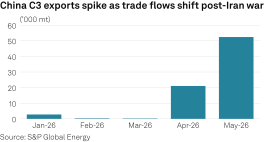
China's propylene exports rose 148.7% month over month to 52,401 mt in May. In April, exports increased significantly to 21,070 mt from 236 mt in March.
Similarly, in South Asia, styrene buyers from India, who had primarily imported from the Middle East, have turned to China for imports. India imported 20,701 mt of styrene from China in March 2026, compared with no imports from China a year ago in March, according to India customs statistics.
However, Chinese trade flows to Northeast Asia and Southeast Asia will likely diminish due to sluggish demand.
"In the second half of 2026, ethylene and propylene exports from China to Southeast Asia are unlikely to continue at recent levels. Weak downstream demand and lower-priced derivative imports from China, such as PE, PVC, and PP, have pressured regional producers' margins and operations, keeping spot monomer demand subdued," said Joyce Lee, director for Asia olefins news and research at S&P Global Energy CERA.
"At the same time, softer demand has eased tight regional olefin supply, and the price gap between Northeast Asia and Southeast Asia is expected to narrow toward year-end," Lee added.
US ethane, propane key feedstocks for Europe, Asia
The closure of the Strait of Hormuz has driven a sharp restructuring of propane and ethane trade flows, with Asian and European buyers turning to US and Canadian suppliers to fill the gap left by absent Persian Gulf barrels.
US ethane prices have stayed relatively low and stable, making it the preferred feedstock in Asia and Europe due to better cracking economics, while naphtha remains exposed to tighter regional availability and higher volatility.
US ethane exports to China had surged to record highs in the first half of 2026, with March shipments reaching 960,600 mt, according to Platts data.
This trend will likely continue into H2 2026. Even with CFR NE Asia ethylene prices softening into year-end, ethane-based cracking is expected to remain structurally profitable, while naphtha margins will remain under pressure, market sources said.
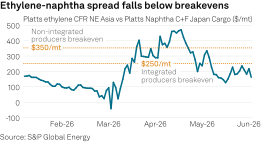
In Europe, market sources also expect propane-to-propylene economics to support PDH operating rates and propane cracking. May's propane-to-naphtha discount had reached a record level, as wide as $266/mt in May, according to Platts data.
Also, with US propane inventories high, US imports will continue to take up the largest share of Europe's total propane imports, market sources said.
"With regards to Europe, we see propane and ethane being very much in favor over naphtha where flexible crackers can flex feedstocks, and we will continue seeing strong favorability for propane and ethane over naphtha throughout the rest of the year," said Bill Rawlusyk, S&P Global CERA director for Canadian NGLs news and research.
"European pricing is largely based on the US price plus freight costs. As the US market has been largely insulated from the impacts of the Iran war, prices remain quite low in the US and are expected to stay moderate throughout 2026," he said.
Despite better cracking economics, however, naphtha still remains the main feedstock for crackers across Europe and Asia.
Europe will remain a net importer of naphtha, with Northwest Europe's import dependency expected to persist as domestic production stays constrained and Middle East supply remains well below prewar levels.
