Refined Products, Chemicals, Naphtha
June 29, 2026
H2 OUTLOOK: Asian chemical makers wary on operations amid feedstock concerns
Editor:
HIGHLIGHTS
Asian MTBE producers cut output on feedstock woes
Butane prices drop to $623/mt from $1,030 peak
China boosts olefin exports amid cracker cuts
Asian chemical producers are likely to maintain low production rates in the near term as feedstock availability remains a concern due to the Middle East conflict, despite the announcement of a much-awaited peace deal, producers, traders and other market sources said.
Several Asian chemical producers have opted to halt production entirely or reduce operations, as key feedstocks such as butane and naphtha supplies tightened and became expensive, sources said.
Supply-driven dynamics
Even with a peace deal opening the Strait of Hormuz, there remain doubts about a quick and smooth resumption of feedstock flows, a Chinese MTBE producer said.
In May, some Chinese MTBE production went offline, with more such supply cuts lined up through June and July.
Despite expectations of more butane supplies from the Middle East and lower prices, producers cited tight near-term availability and weak MTBE demand as barriers to increasing production.
An Asia-based trade source said the propane-butane spread should continue to narrow, with butane prices likely to trend lower amid seasonal weakness in India. Demand is expected to pick up after the monsoon period late the third quarter ahead of Diwali.
Platts assessed the FOB Arab Gulf butane price at $623/mt June 17, the lowest level since March 13, when prices were assessed at $617/mt. Prices peaked at $1,030/mt May 18, the highest point since 2021 when Platts started assessing the FOB Arab Gulf price.
Chinese producers have cut production to around 55%, and there are few signs of a positive impact from those supply cuts, some Chinese traders said.
MTBE spot prices for China-origin cargoes dropped to near three-month lows, giving domestic producers little incentive to increase production.
In the Straits region around Malaysia and Singapore, prices have remained depressed, with the trend expected to continue, a Singapore trader said, citing limited supplies of gasoline available to blend MTBE into.
The current arbitrage for MTBE to Europe and Latin America may shrink once the conflict ends, limiting the flows of Chinese MTBE to the west, a second trader in Singapore said.
If demand does not pick up, those barrels would be left in Asia, further weakening regional fundamentals.
Toluene fundamentals
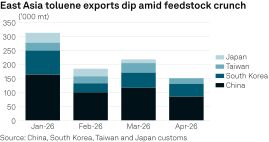
Toluene production faced similar constraints as MTBE in the first half of 2026.
This was reflected in a sharp decline in toluene exports from Northeast Asia from January through April 2026. The two major exporters, China and South Korea, posted substantial month-over-month decreases of 27.85% and 23%, respectively, in April.
While several cargoes moved to the US from Northeast Asia in May and June, tightening regional supply, solvent and blending demand from key Southeast Asian consumers has softened.
Caprolactam-route HMDA advantage set to erode in H2
In the nylon 66 chain, a severe butadiene shortage and surging prices during the Middle East conflict forced several butadiene-based HMDA producers to reduce operating rates or declare force majeure on HMDA and nylon 66 supply in H1.
The disruption opened a favorable market window for caprolactam-based HMDA and its downstream nylon 66 products, which benefited from better feedstock availability, lower relative feedstock and processing costs amid a caprolactam surplus.
New caprolactam-based HMDA capacity entered the market in May, including Eversun's 30,000 mt/year unit and Risun's 50,000 mt/year unit with certain producers beginning to offer discounted volumes by early June to capture market share in the HMDA and nylon 66 value chains.
Market sources expect the caprolactam route's cost advantage to erode in H2 as butadiene prices fall sharply and the domestic China caprolactam-butadiene spread widens to more than Yuan 1,600/mt following the easing of US-Iran tensions.
Meanwhile, market conditions are also expected to remain challenging in H2, weighed by a seasonal summer lull, inventory pressure and easing upstream cost support.
China olefin exports
Asia's steam cracker operations moved lower, with the impact most visible in Japanese and South Korean production.
Japan's average operating rates of naphtha crackers sank to a record low of 67.3% in April, according to the Japan Petrochemical Industry Association.
As a result, China has emerged as a key exporter of olefins, with steam cracker operations rising above those in South Korea and Japan due to a lower dependence on Middle East naphtha.
The situation has also prompted unusual trade flows in the region.
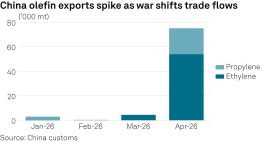
China, typically a net exporter of ethylene, began exporting ethylene from March, with exports rising to 53,943 mt in April, according to data from China's customs agency.
Exports of Chinese-origin olefins were expected to persist through the latter half of the year as buyers turn to China to fulfill their import requirements.
China's exports have also cooled Asia's spot olefins prices. As of June 12, Asia's ethylene market slid to $900/mt CFR NE Asia, plunging from a 12-year high of $1,500/mt marked March 31, according to Platts data.
