Chemicals, Olefins, Polymers
March 13, 2026
Polypropylene prices rise globally following outbreak of Middle East war
By Alex Fiedosiuk and Nayana Khosla
HIGHLIGHTS
Asia price rises $330/mt since March 2
Middle East export halt tightens supply
Producers declare force majeure on output
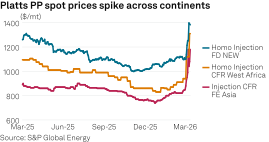
Polypropylene prices rose worldwide so far in March following the outbreak of the war in the Middle East, according to data from Platts, part of S&P Global Energy.
Prices for PP homopolymer injection-grade Europe have risen Eur220/mt since the start of March, according to Platts data, with the homopolymer injection-grade FD NWE spot price now at Eur1,200/mt.
In the Africa markets, Platts assessed the CFR North Africa PP raffia spot price at $1,290/mt March 11, up $190/mt week over week, the biggest week over week increase since the start of the assessment on March 17, 2021. Additionally, CFR West African raffia prices gained 39% since the start of the conflict, according to Platts data.
Asian prices have seen the most significant increase. Platts assessed the PP injection CFR Far East Asia spot price at $1,180/mt, up $330/mt since March 2.
The price increases have been driven by a combination of shocks stemming from the Middle East war, including tighter supply from the Middle East due to the cessation of offers and rising feedstock and energy costs, leading some producers to halt PP production in Asia and Europe.
Middle East supply
The Middle East accounts for close to 25% of global PP and polyethylene exports, according to S&P Global Energy data.
Transit via the Strait of Hormuz has essentially stopped, resulting in many major container carriers suspending shipments out of the Persian Gulf, slashing exports from the region, Platts reported March 4.
"Producers are declining to confirm offers," a European trader said, referring to the drop in availability out of the Middle East into Europe.
In Africa and Turkey, offers from all origins have reduced, with sellers citing volatile upstream costs and climbing freight prices. Middle Eastern suppliers, who had historically been the dominant source for African and Turkish markets, withdrew most of their offers within days of announcing them, as conditions changed rapidly.
Buyers remained skeptical of lead times from Middle Eastern suppliers amid stalled Strait of Hormuz transit and congestion at regional ports, according to regional distributors. Some suppliers explored trucking material from Saudi Arabia's eastern to western coasts, though market participants noted that such logistics proved technically challenging.
In West Africa, trading activity remained largely halted from March 2 onwards as most offers were withdrawn or suspended, regional producers said.
In Turkey, Russian and local Turkish materials emerged as options for prompt requirements, while Middle Eastern materials faced uncertain delivery, and Asian materials remained largely absent, according to Turkish producers. Demand improved during the week despite overall low Ramadan consumption, as some converters sought prompt material for post-Ramadan delivery to European customers, the sources said.
Producers cut rates
The amount of oil exported into Asia has fallen by 15.6 million barrels/day, according to S&P Global Energy, with knock-on effects for downstream production.
Upstream, the decline in propane and naphtha feedstock availability has led producers to reduce operating rates, further compounding the tightness caused by lower import volumes.
In South Korea, LG Chem cut operating rates to a minimum of 60% at all naphtha-fed steam crackers in Yeosu and Daesan. Downstream, price increases in feedstock led producers such as Thailand's IRPC and Taiwan's Formosa Plastics to declare force majeure on production.
In Europe, many producers have also placed order stops to ensure they retain enough volume to meet contractual supply obligations, severely reducing spot PP availability. This week, LyondellBasel issued a force majeure on its European polyolefin production, citing high energy and feedstock costs.
As the conflict continues and the shipping situation out of the Persian Gulf remains tight, market participants are bracing for further tightness and the continuation of elevated feedstock prices.
"We have seen a realisation in the market that a longer period of supply disruption from the Middle East will mean a bigger impact at the end of the day," a European producer said.

Editor: