Agriculture, Refined Products, Natural Gas, Energy Transition, Biofuels, Gasoline, Diesel-Gasoil, Grains, Rice, Carbon
September 30, 2026
India adds biofuels to vehicle efficiency compliance rules

Editor:
HIGHLIGHTS
Biofuels gain CO2 compliance discounts
Ethanol capacity exceeds E20 blending volume
Automakers can trade efficiency credits
India has formally incorporated ethanol, compressed biogas and other biofuels into its vehicle-efficiency compliance system, strengthening incentives for automakers to introduce flex-fuel and biofuel-compatible vehicles, according to a Sept. 29 government notice.
The Ministry of Power has notified the Corporate Average Fuel Economy norms for fiscal years 2027-28 (April-March) through 2031-32, effective April 1, 2027, establishing carbon neutrality factors that reduce the emissions value assigned to vehicles operating on eligible biofuel blends, according to the notice.
Vehicles using gasoline blended with 20% ethanol, or higher blends subsequently specified by the government, will receive an 8% carbon neutrality factor on declared tailpipe carbon dioxide emissions. The provision also covers strong hybrids and plug-in hybrids using ethanol-blended gasoline.
The discount increases to 22.3% for flex-fuel ethanol vehicles, defined under the notification as vehicles capable of operating on gasoline-ethanol blends containing 85% ethanol (E85), and on 100% ethanol (E100). Flex-fuel vehicles also receive a 1.1 volume multiplier, or super-credit, when manufacturers calculate fleet-average compliance.
Plug-in and strong-hybrid flex-fuel vehicles will receive a higher 2.5 multiplier, compared with 1.6 for conventional strong hybrids and 3 for battery-electric and range-extended electric vehicles, the power ministry said.
CBG blending gains regulatory value
For vehicles running on compressed natural gas, the carbon-neutrality factor will be either 5% or the compressed biogas blending percentage notified by the Ministry of Petroleum and Natural Gas, whichever is higher, according to the notice.
The mechanism means that a future increase in the notified CBG blending share would increase the carbon-neutrality factor available to CNG vehicles, provided the notified percentage exceeds 5%. The framework does not, however, establish a new CBG blending mandate or specify a future blending rate.
Diesel vehicles will similarly receive a carbon neutrality adjustment based on the actual biofuel blend specified by the petroleum ministry, the notice said.
Post-E20 demand outlet
The ethanol incentives arrive as India's production capacity has moved ahead of the required E20 blending volumes.
According to a US Department of Agriculture report, India's annual ethanol production capacity increased from 6 billion liters in 2021 to 22 billion liters as of April 2026, while capacity utilization was forecast at only 51.5% for calendar year 2026.
The report said grain-based sources supplied 73% of ethanol, led by corn at 46%, with damaged grains and government rice stocks contributing another 27%.
That growing capacity has shifted the policy discussion from achieving E20 toward creating additional end-use markets.
Flex-fuel vehicles are particularly important because they can consume E85 or E100, offering an outlet for significantly more ethanol per vehicle than the nationwide E20 pool.
"The recognition of ethanol and flex-fuel vehicles through a 22.3% Carbon Neutrality Factor and 1.1x super-credit provides greater policy visibility to biofuels and gives automakers a clearer framework to plan for flex-fuel technologies. For the ethanol industry, this creates an enabling framework for the next phase of growth, while giving automakers greater clarity to plan and invest in flex-fuel technologies," Vijendra Singh, president, All India Distillers' Association, said.
Earlier draft discussions had prompted the Indian Sugar & Bio-Energy Manufacturers Association to seek a restoration of stronger flex-fuel incentives, including an increase in the volume multiplier from 1.1 to 1.5. The final notification retained the 1.1 multiplier, while confirming the 22.3% carbon neutrality factor.
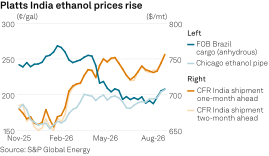
Platts, part of S&P Global Energy, assessed Asian fuel ethanol up $8/cubic meter week over week at $681.67/cubic meter CIF Philippines on Sept. 28, amid stronger US ethanol futures.
Ethanol futures fluctuated throughout the week, but remained above $2/gal over the September-November period. Ethanol futures for October hit $2.2/gal on Sept. 25, Platts data showed.
Tradable compliance value
The norms also introduce a credit-and-debit mechanism that gives direct economic value to fleet performance.
According to the norms, manufacturers beating their annual average fuel-consumption target will generate credits, while those exceeding the target will record debits in individual compliance passbooks. Credits and debits can be carried forward within a compliance block, with the first block covering three years from 2027-28 and the second covering two years beginning in 2030-31. Unsettled credits expire at the end of each block.
Automakers will be permitted to trade credits among themselves on mutually agreed terms. Manufacturers with remaining deficits can purchase credits from the Bureau of Energy Efficiency at prescribed prices rising from 2,500 rupees/gram CO2/km in fiscal 2027-28 to 4,500 rupees/gram CO2/km in fiscal 2031-32, the notice said.
The credit framework, therefore, gives automakers a financial reason to consider biofuel-compatible models alongside electric vehicles, hybrids and conventional efficiency improvements when managing their fleet mix.
The Ministry of Road Transport and Highways will develop and enforce testing, reporting and calculation methodologies, including those covering biofuel carbon neutrality factors and super-credits, according to the notice.
