Agriculture, Grains
August 07, 2026
ASIA WHEAT ROUNDUP: Australian prices hit 13-month high in July amid Russia-Ukraine escalation

By Vivien Tang
Editor:
HIGHLIGHTS
Crop conditions remain excellent across most of Australia
Black Sea disruptions drive demand to Argentina
Australian wheat prices hit a 13-month high in July, as Russia and Ukraine increasingly exchanged strikes on port infrastructure and commercial vessels, critically disrupting Black Sea shipments during their new crop harvest window.
Australian prices rally in July, buyer interest limited
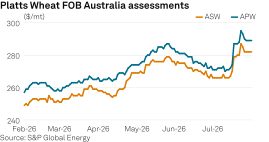
Platts, part of S&P Global Energy, assessed Australian Premium White wheat at $289/metric ton July 31, up $18/mt from the start of the month July 1, while Australian Standard White with no protein guarantee rose $16/mt to $282/mt during the same period.
Prices were rangebound throughout the first half of July as the demand window approached the end of Australia's marketing year in September, but soon spiked as attacks on port infrastructure and commercial vessels ramped up expectations of shifting to non-Black Sea origins, including Australia, according to multiple trade sources in Asia and Australia.
Australian Premium White and Australian Standard White with no protein both hit a 13-month high on July 23 at $295/mt and $287/mt, respectively.
"There are a lot of price inquiries [from Southeast Asia]," said a trade source based in Perth. "Grower sales for wheat picked up massively in the 2nd last week of July," said another trade source based in Victoria.
However, several Australian traders and brokers said the rally in Australian wheat prices was so rapid that it stymied regional buyers' appetite, with fewer bulk shipment trades materializing than anticipated, and FOB prices softened toward the last week of July.
Meanwhile, crop conditions have remained positive across most of Australia, with decent precipitation in the wheat belt, except in northern New South Wales and Queensland, according to several Australian traders and brokers. While the El Nino forecast continues to loom over the country, its actual impact on the marketing year 2026-27 (October to September) crop will largely depend on the timing of its onset, a Victoria-based trade source said.
"If El Nino lands between now to October, then certainly it won't be good news for the crop, but if it only arrives at the end of October or later, that's actually perfect to dry out the fields for harvest," the trade source said.
Trade estimates of Australia's national wheat production for the 2026-27 crop are close to 30 million mt, but remain vulnerable to downward revisions depending on weather developments in August-September.
Buyers switch to bulk Argentine wheat amid Black Sea disruptions
As Black Sea and Australian wheat prices surged on the heels of disrupted export logistics in Russia and Ukraine, Argentine wheat offers entered the market for August to October shipments, outside their usual export window between November to April, said several Asian trade sources.
Competition from Argentina limited the volume of switching from Black Sea supplies to Australia, with delivered prices for Argentine 11.5% wheat seen in the $290s/mt CFR range, versus nearly $310/mt for Australian Standard White with 9% protein guarantee mid-July, according to several Southeast Asian grains traders.
"The non-executed Black Sea [cargoes] are mainly replaced by Argentina. Australia raised their price too fast and too high in the end," said a Singapore-based grains trader. The same trader and two other Asian wheat traders said regional buyers mostly sought Australian shipments in bulk containers to meet near-term demand.
As wheat prices soared, regional interest in feed wheat has also waned, with delivered corn prices to Asia at least $20/mt below the most competitive origins of feed wheat for late Q3 to early Q4 shipments, several Asian feed grains traders said.
"Philippines buyers are shying away from firmer [feed wheat] numbers. Some have been switching to South American corn," said a Manila-based trade source.
Thailand feed buyers have also been largely absent from the feed wheat market throughout most of July, two Bangkok-based trade sources said.
What's next in Asian wheat markets?
Asian wheat buyers are closely monitoring developments in the Black Sea, and a prolonged disruption to safe passage is expected to keep Australian wheat prices elevated in the near term, several Asian trade sources said.
Feed wheat demand is expected to remain subdued across the region, except in destinations with inelastic demand, such as the Philippines, as high global wheat prices should continue to support a wide feed wheat-corn spread, according to several Southeast Asian trade sources.
