Agriculture, Energy Transition, Refined Products, Biofuels, Renewables, Jet Fuel, Gasoline, LPG, Naphtha, Vegetable Oils
July 17, 2026
Taiwan, South Korea push alcohol-to-jet as Asia next SAF pathway

Editor:
HIGHLIGHTS
Taiwan, South Korea push alcohol-to-jet SAF tech
Taiwan's SAF demand to reach 182,000 mt by 2030
Asia-Pacific ATJ capacity to hit 4 mil mt by 2030
Alcohol-to-jet technology is gaining commercial traction in Taiwan and South Korea as both markets position ethanol-based sustainable aviation fuel as the pathway best suited to overcome domestic feedstock constraints, with policy developments and industry engagement accelerating across the region even as analysts warn that demand-side mandates remain the critical missing piece.
Taiwan's sustainable aviation fuel demand could reach 182,000 mt by 2030 under a 5% blending mandate, while South Korea hosted a July 2-3 conference on biofuels and SAF that highlighted alcohol-to-jet's role in meeting the country's 2030 blending targets, according to the US Grains and BioProducts Council (USGBC).
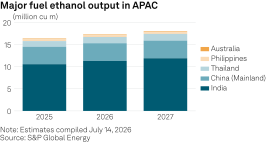
The parallel momentum in both markets reflects a broader strategic shift across Asia-Pacific, where rising electric vehicle adoption is expected to free ethanol currently blended into gasoline and ease concerns over future waste-based oil-derived feedstock constraints that threaten to limit hydroprocessed esters and fatty acids production.
Taiwan has completed its national standard for E10 ethanol-blended gasoline, establishing a regulatory framework that could accelerate bioethanol adoption in its transport sector as policymakers seek to reduce carbon emissions and enhance energy security.
The Bureau of Standards, Metrology and Inspection under the Ministry of Economic Affairs officially announced two national standards for E10 ethanol gasoline, CNS 12614 for unleaded gasoline and CNS 15109 for denatured fuel ethanol, marking a new stage in Taiwan's ethanol gasoline policy.
"Alcohol-to-jet is the next technology to scale after HEFA," Flyn van Ewijk, LanzaJet's regional director for Asia Pacific, said. "As we get more EVs on the roads, you're going to have more ethanol available for SAF."
Taiwan's ATJ pivot
A policy white paper released by Taiwan's Chung-Hua Institution for Economic Research argues that ATJ should become Taiwan's principal SAF production pathway through 2035 because Taiwan lacks sufficient waste oils to support large-scale HEFA production.
The projection assumes 2% annual growth in aviation fuel demand from a 2025 base of 3.28 million mt, with demand potentially reaching 200,500 mt under an optimistic scenario assuming 4% annual growth driven by Taiwan's strengthened role as a regional air transport hub.
The white paper sets 2035 as a critical policy review point, arguing that the global supply of oils and fats for first-generation HEFA technology will reach a ceiling by then.
By establishing a robust bioethanol import system, Taiwan could position itself as a regional conversion and blending hub, effectively addressing the critical constraint of insufficient domestic oilseed feedstock, Chen added.
The white paper proposes a phased policy framework with 2030 serving as a transition point from demonstration to institutionalized implementation, recommending that Taiwan's Ministry of Transportation prioritize setting a 3% or 5% SAF blending target by 2030 to establish clear market signals.
However, S&P Global Horizons analyst Chua Wei Jun said Taiwan currently has E3 gasoline available only at selected retail stations, he said, adding that its fuel ethanol is almost entirely imported rather than domestically produced.
"A nationwide E10 mandate can act as a stepping stone for domestic ATJ supply development in the longer term, as higher electric vehicle penetration can divert a surplus of fuel ethanol toward a stable feedstock supply for ATJ production," Chua said. Horizons estimates a nationwide E10 mandate would require about 1 billion liters per year of fuel ethanol.
South Korea engagement as capacity buildout accelerates
The USGBC conference engaged major South Korean policymakers, refiners, airlines, researchers, fuel suppliers and energy stakeholders about the role of ethanol and other biofuels in advancing energy security, transportation decarbonization and sustainable fuel development.
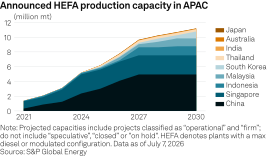
Asia-Pacific's ATJ capacity could reach nearly 4 million mt by 2030 when combining announced and speculative projects, compared with just 46,000 mt in 2026, according to S&P Global Energy data. That would still trail the region's HEFA capacity, which stands at around 8 million mt in 2026 and is projected to reach 11 million mt by 2030 based on announced plants with maximum diesel or modulated configuration.
The announced capacity of ATJ-SPK projects in the region stands at 906,000 mt by 2030, while estimated speculative projects add over 2.7 million mt, bringing total ATJ-SPK capacity to nearly 4 million mt by decade's end.
Feedstock diversification critical
Sustainable aviation fuel producers across Asia-Pacific must aggressively diversify away from used cooking oil toward palm residues, non-edible oilseed crops, microalgae, and alcohol-to-jet pathways, experts said warning that reliance on a narrow feedstock base represents the biggest structural risk facing new SAF projects.
Caleb Wurth, regional director for USGBC said volume constraints will force rapid diversification. With the major volumes aviation requires, all feedstocks available that are responsible and fit the end goal of decarbonization will be needed, including sustainable corn in the US, palm products in Malaysia, coconut products in the Philippines and starch products in Thailand.
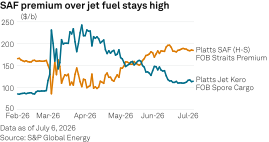
Platts, part of S&P Global Energy, assessed sustainable aviation fuel HEFA-SPK FOB Straits at $2,475/metric ton July 17, unchanged from July 16. Platts assessed SAF HEFA-SPK FOB China at $2,462/mt July 17, unchanged on day.
