Agriculture, Oilseeds
July 07, 2026
Managed Money shifts from long liquidation to fresh short selling as soybean oil correction deepens

Editor:
HIGHLIGHTS
Funds shift to fresh short selling positions
Net long position drops 11,357 contracts
Commercials reduce shorts as prices fall
The latest CFTC Commitments of Traders report suggests the nature of June's correction in Chicago Board of Trade soybean oil futures evolved materially during the week ended June 30, with speculative funds transitioning from primarily liquidating bullish positions to actively establishing new bearish bets following bearish US Department of Agriculture supply data.
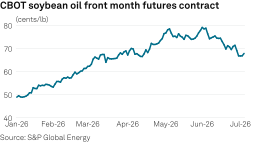
CBOT August soybean oil futures settled at 66.93 cents/lb on June 30, down 2.8% on the day after the USDA reported larger-than-expected quarterly soybean stocks and higher US planted acreage. The selloff was one of the largest single-session declines of the recent correction, with August futures falling 12.6% from 77.53 cents/lb on June 1 to 67.76 cents/lb by July 6.
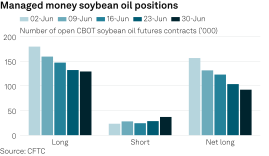
The latest COT data suggest speculative sentiment became increasingly bearish as Managed Money participants shifted from primarily liquidating long positions to establishing new short positions. Managed Money -- which includes commodity trading advisors, hedge funds and other speculative investment managers -- held 129,157 long contracts and 36,925 short contracts as of June 30, leaving the category net long 92,232 contracts, down from 103,589 contracts a week earlier.
During the latest reporting week, funds reduced long positions by 2,929 contracts while adding 8,428 new short positions, producing an 11,357-contract decline in net length. Unlike previous weeks, when declining net length was driven largely by long liquidation, the latest report points to growing conviction behind outright bearish positioning.
Since peaking at 156,433 net long contracts on June 2, Managed Money has reduced its net long position by 64,201 contracts (41%). Over that period, funds liquidated 30,223 long positions and added 33,978 short positions, underscoring a broad deterioration in speculative sentiment as expectations for larger US and global soybean supplies weighed on prices following the USDA's June Acreage and Grain Stocks reports.
Commercial participants moved in the opposite direction
The Producer/Merchant/Processor/User category -- which includes crushers, exporters, processors and other physical market participants -- remained heavily net short but reduced bearish exposure during the week.
Producer/Merchant longs declined by 6,213 contracts while short positions fell by 11,011 contracts, reducing the group's net short exposure by 4,798 contracts. Market participants said this positioning is consistent with commercial hedgers reducing forward hedge coverage as futures prices decline rather than increasing bearish exposure.
Swap Dealers also became more constructive during the reporting period.
Long positions increased by 4,190 contracts while short positions declined by 2,237 contracts, expanding the category's net long position to 80,643 contracts.
Meanwhile, Other Reportables adopted a modestly more bearish stance, reducing long positions by 3,136 contracts while trimming shorts by 1,869 contracts. Nonreportable traders reduced exposure on both sides of the market but remained modestly net long.
Taken together, the commercial categories suggest physical market participants were generally absorbing speculative selling rather than contributing to it, reinforcing the view that the sharp decline in futures was driven primarily by financial flows.
Futures correction contrasts with resilient physical soybean oil markets
The divergence between speculative futures positioning and commercial activity mirrors the broader disconnect that has developed between financial and physical soybean oil markets through June.
Since reaching multiyear highs in early June, CBOT soybean oil futures have corrected sharply as speculative funds reduced bullish exposure amid improving US crop prospects, bearish USDA supply data and expectations for record global soybean supplies.
Physical FOB soybean oil markets in Argentina and Brazil, however, have remained comparatively resilient.
Nearby export prices have continued trading within a relatively narrow range despite the sharp decline in futures, supported by a substantial recovery in FOB basis levels and steady international demand. Stronger basis values have offset much of the decline in CBOT futures, allowing South American export prices to remain relatively stable.
Market participants noted that the reduction in commercial net short exposure observed in the COT report is consistent with conditions seen in physical export markets, where crushers, exporters and end users have continued actively participating despite futures market weakness.
The latest COT report therefore reinforces a theme that increasingly defined the soybean oil market in June: while CBOT futures have been driven lower by speculative repositioning and changing macro sentiment, physical soybean oil fundamentals have remained considerably more resilient.
As long as export demand remains steady and South American logistics continue operating normally, traders said physical soybean oil markets are likely to remain supported even if speculative positioning continues to generate elevated volatility in CBOT soybean oil futures.
