Agriculture, Meat
July 07, 2026
INFOGRAPHIC: ASF hits Spanish pork prices, exports as feed costs climb
Editor:
HIGHLIGHTS
ASF outbreak cuts Spanish pork prices 36%
Feed costs hit record highs amid supply strain
Spain's pork sector is facing dual pressure as African swine fever outbreaks and fallout from the Middle East conflict drive a sharp divergence between meat and feed markets: pork prices have slumped to multiyear lows even as feed costs in April hit their highest levels since Platts, part of S&P Global Energy, launched Spain corn and soybean meal assessments in 2025.
The ASF outbreak has triggered export bans from key Asian buyers, swelling inventories and pushing Spanish pork prices well below production costs, even as relatively steady output exacerbates oversupply. At the same time, elevated but easing soybean meal and corn prices, shaped by ample origin supplies and lower oil prices, are feeding through into ration costs.
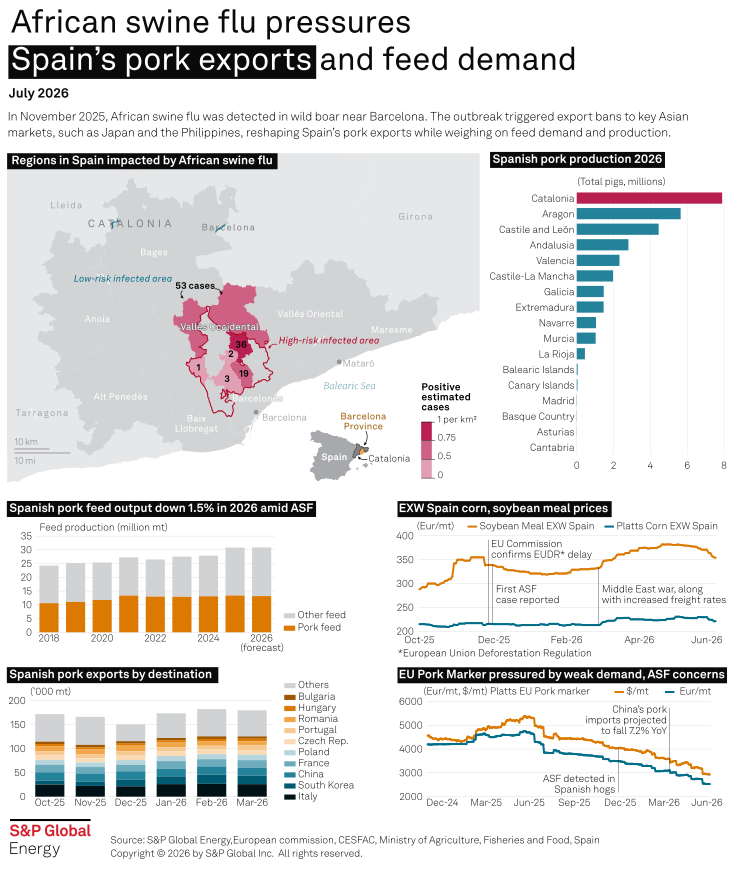
Platts assessed the EU Pork Marker at Eur2,277/metric ton July 6, down 36.4% from October 2025 levels, as elevated belly inventories and weak demand compounded pressure from ASF-related trade restrictions.
With sufficient supplies from origin and lower oil prices, Platts assessed EXW Spain soybean meal at Eur348/mt July 6, down Eur34/mt from the peak of Eur382/mt on April 29. Platts assessed the EXW Spain corn price at Eur223/mt July 6, down Eur7/mt from Eur230/mt on May 22, the high since the start of the assessment.
Spain remains Europe's largest pork producer, accounting for about 27% of total EU pork output in 2025, according to the European Commission, even as weaker prices, export restrictions and margin pressure continue to weigh on the sector.
The strain is also reflected in the feed market, with Europe's total feed output forecast to decline 1.5% in the marketing year 2025-2026 from 13.36 million mt to 13.16 million mt, according to data from the Spanish Confederation of Animal Feed Manufacturers, or CESFAC.
ASF pressures Spain's pork exports, feed demand
The Spanish pork market began to face the disruption in November 2025, when the ASF was first detected in wild boar near Barcelona, triggering immediate export bans from key Asian markets, including Japan and the Philippines, according to Spain-based pork traders. By July 2, the outbreak had reached 358 confirmed cases, comprising three primary and 56 secondary cases across 13 municipalities in Catalonia's Barcelona metropolitan area, according to the Ministry of Agriculture, Fisheries and Food, or MAPA.
Spanish pork prices in June have fallen 25% year over year, with the Class E carcass price averaging Eur162/100 kg in April, well below the five-year average of Eur228/100kg, according to data from S&P Global CERA.
"The cost to produce 1 kg of pork in Spain was Eur1.35/kg while the selling price was around Eur1.27/kg, meaning the industry and producers were operating at a loss," a Spain-based feed association said.
Despite the disruption, Spanish pork production has remained firm, with output in February rising 6.8% year over year to 492,000 mt, even as export uncertainty and weaker prices weighed on market sentiment, the association said.
The stable production intensified oversupply after major buyers such as Japan and the Philippines initially closed their markets to Spanish pork following the ASF outbreak, putting further pressure on domestic and regional supply, a Spain-based trader said. Some relief came on May 7, when the Philippines lifted its temporary ban under a regionalization agreement, offering exporters a partial outlet, although weak prices and accumulated inventories continued to weigh on the market, the trader added.
Spain exported 187,000 mt of pork in March, according to CERA data. Italy was the largest destination at 26,865 mt, followed by South Korea at 19,089 mt and China at 17,124 mt.
ASF effects are now extending beyond meat exports into Spain's feed market, with feed traders and brokers saying demand is beginning to reflect strain in the pork sector, although estimates differ.
Another trader in Spain said there was no immediate effect on feed demand when the first ASF outbreaks were confirmed, but added that the impact "is visible in the market" now.
Other Spanish traders and procurement managers estimated the decline in feed demand at roughly 2%-8%. Still, the extent of the drop remains disputed, as it depends on the animals' production stage, a procurement manager said.
A Spain-based broker said that if Spanish pork production falls by as much as 20%, it would translate into a direct hit to feed demand.
Outlook
Pork feed production is forecast to decline by 1.5% in 2026, while feed output for sheep and goats is expected to fall by 3.2% and feed for horses and rabbits by 1.8%, according to CESFAC data.
However, Spain's overall feed production is still projected to edge up by 0.1%, supported by growth in cattle, poultry and marine animal feed, the data showed.
Feed traders and brokers highlighted additional market challenges, including the EU Deforestation Regulation, which affects feed raw material prices and, consequently, pork feed formulation in Spain.
