Agriculture, Vegetable Oils, Biofuels
July 03, 2026 · Updated July 06, 2026
Malaysia’s palm oil sector faces El Niño yield hit as B15 mandate lifts demand
Editor:
HIGHLIGHTS
El Niño threatens palm oil yields in 2026-27
B15 biodiesel mandate boosts domestic demand
Ending stocks fall to 2.56 million mt in 2026-27
Malaysia's palm oil industry is heading into a tighter supply-demand balance in marketing year 2026-27 (October-September) as El Niño-linked dry weather threatens fresh fruit bunch yields just as the country ramps up its B15 biodiesel mandate, according to a new US Department of Agriculture oilseeds and products update.
The report, released July 1, 2026, warns that MY 2026-27 palm oil production is expected to moderate after strong output in MY 2025-26, with policy-driven biodiesel demand set to absorb more of the available supply and slow stock accumulation.
El Niño set to curb palm oil output
The USDA has lowered its MY 2026-27 palm oil production estimate to 19.7 million metric tons, down from an earlier forecast, citing expected dry conditions associated with El Niño from June 2026 well into 2027. Moisture stress is seen limiting fresh fruit bunch, or FFB, yields, with the impact largely reflected in the third and fourth quarters of the marketing year as oil palm productivity typically responds with a lag.
By contrast, MY 2025-26 output has been revised up to 20.0 million mt, an increase of 300,000 mt, after cumulative production from October 2025 to May 2026 exceeded the corresponding period a year earlier by more than 1 million mt, despite some slowdown in April-May. Area harvested is projected to be broadly stable at 5.15 million hectares in MY 2025-26 and 5.16 million ha in MY 2026-27, in line with Malaysian Palm Oil Board data.
The USDA expects the palm kernel complex to follow a similar pattern, with lower FFB yields reducing kernel availability for crushing in 2026-27 and modest declines in palm kernel meal and palm kernel oil production compared with MY 2025-26.
Biodiesel mandate boosts domestic palm demand
On the demand side, Malaysia's move from B10 to B12 and now toward B15 biodiesel blending is set to increase industrial palm oil use materially over the next two marketing years. The report notes MPOB estimates that the shift from B10 to B12 adds about 130,000 mt/year of palm demand, while expansion to B15 could add a further 204,000 mt, with the full-year impact expected in MY 2026-27 following the June 1, 2026, start of Peninsular Malaysia's B15 mandate.
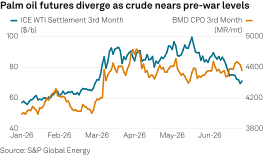
The USDA now projects MY 2026-27 domestic palm oil consumption at 4.59 million mt, up 330,000 mt year over year, reflecting higher industrial use from biodiesel producers. MY 2025-26 consumption has been revised to 4.35 million mt, as the mandate is only in place for the final months of that year and ramps up incrementally.
Food use is forecast to be broadly stable at 950,000 mt in MY 2026-27 and 940,000 mt in MY 2025-26, signaling steady household and food manufacturing demand.
The stronger domestic pull is expected to slow stock accumulation but not trigger outright shortages. Ending stocks are forecast to fall from 2.8 million mt in MY 2025-26 to 2.56 million mt in MY 2026-27, with supplies still sufficient to cover both local needs and export commitments.
Trade flows
With production easing and domestic demand rising, Malaysia is expected to lean more on imports and draw down inventories to balance the market. The USDA has raised palm oil imports for both MY 2025-26 and MY 2026-27 to 550,000 mt, reflecting higher arrivals so far this marketing year and the need to supplement supplies under the B15 mandate. Imports between October 2025 and April 2026 reached about 290,000 mt, supported by strong regional availability from Indonesia as exporters accelerated shipments amid uncertainty over Jakarta's new palm governance framework.
Meanwhile, palm oil exports are projected to remain robust. The export estimate for MY 2025-26 has been revised up to 15.75 million mt, while MY 2026-27 exports remained at 15.9 million mt.
Demand is expected to be anchored by key buyers such as India, Kenya and China, though growth may be capped by competition from Indonesia, a weakened price discount versus other oils and higher domestic biodiesel use.
The USDA report highlighted that US soybean oil prices have continued to rise and remain at a substantial premium to palm oil, although palm's discount to Argentine and Brazilian soybean oil has narrowed, contributing to a highly competitive global vegetable oil market.
This pricing configuration has supported Malaysian palm oil exports into price-sensitive destinations, particularly India, the USDA said.
Platts, part of S&P Global Energy, assessed the CPO CFR WC India price at $1,213.50/mt July 3 for July loading, down $2.50/mt from July 2, while the August shipment was $3.50/mt higher than the July price.
