Agriculture, Grains
July 03, 2026
ASIA WHEAT ROUNDUP: Australian prices fall in June; buyers await new crop from Canada, Black Sea

By Vivien Tang
Editor:
HIGHLIGHTS
Australian wheat prices fall on rain, weak dollar
East Coast sellers pressured by high old-crop inventories
Regional buyers await cheaper new-crop supplies
Australian wheat prices softened in June, tracking favorable weather conditions across most cropping regions and bearishness from a weaker currency, but levels remain too expensive compared with the Black Sea and Canada, where large, upcoming harvests have added further bearishness to regional buying ideas.
Rains continue to reshape new crop expectations despite El Nino forecast
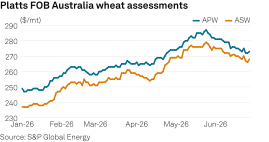
Platts, part of S&P Global Energy, assessed Australian Premium White wheat at $273/metric ton June 30, down $9/mt since the start of the month June 2, while Australian Standard White fell $6/mt to $268/mt during the same period.
Prices softened throughout much of June as swathes of the Australian wheat belt received rain since late May, improving crop prospects across multiple states, according to several Australian trade sources.
Sources also cited bearish influences from a weaker Australian dollar in June. The Australian dollar closed the month at 69.19 US cents June 30, down 3.3% from 71.58 cents June 1.
There was greater urgency to sell on the East Coast, where growers had been holding onto old-crop stocks as a hedge against potentially lower production in the 2026-27 marketing year (October to September) due to a super El Niño forecast. However, widespread rains have vastly changed new-crop prospects, at least in the near term, according to several trade sources in Perth and Victoria.
"The season is very positive. The El Niño is interesting. There is still a lot of media [coverage] around it in Australia. But the facts are, we keep getting widespread excellent rain. So, who knows if [or] when it cuts out," a Victoria-based trade source said.
There is also little concern about the availability of diesel and fertilizer inputs for the 2026-27 season, with prices coming off their peaks during the US-Iran war and the reopening of the Strait of Hormuz as peace deal negotiations continue. However, higher prices paid earlier in the year may fuel reluctance among growers to sell at current wheat price levels, two Australian trade sources said.
Buying ideas dip as Black Sea, Canada prices decline
Beyond Australia, other key exporters such as Canada and the Black Sea, are also looking at positive new crop outlooks, and both regions will again pose stiff competition to Australia in Asian markets for the 2026-27 season, according to several Southeast Asian trade sources.
Several grain traders said regional buying expectations for both Black Sea and Canadian milling wheat were depressed in anticipation of large production in both regions. However, offers are not yet reflecting huge declines, for various reasons ranging from harvest delays to slow new-crop grower sales. The wide bid-offer gap was curbing significant trade volumes for new-crop shipments.
Unseasonal rains have led to some harvest delays in southern Russia and Ukraine, while delayed planting and wet weather in Alberta and Manitoba are expected to push back the main harvest window in Canada by at least several weeks, according to several European and Canadian wheat traders.
"Growers are also no longer selling old crop in Canada, and so exporters are cautious about offering new crop too aggressively in case they cannot accumulate in time for the new-crop shipment window," said a Canadian wheat trader.
China's domestic wheat harvest campaign is nearly complete, with harvest progress crossing the 96% mark on June 19, according to the latest data from China's Ministry of Agriculture and Rural Affairs. While there are no major concerns about yields, untimely rains in some harvesting provinces have impacted crop quality, which could support import demand for mid-protein milling grades, particularly from Australia, according to local news reports and trade sources in China and Australia.
Regional feed wheat demand has also faltered amid low corn prices, with feed corn offers to Vietnam heard around mid $250s/mt CFR in the last week of June, more than $10/mt lower compared to the cheapest feed wheat origin, currently the Black Sea, said several Southeast Asian feed buyers and traders.
Notably, Thailand has been absent from the international feed wheat market, as the industry focuses on facilitating 1 million mt of tariff-free US corn imports agreed upon in November 2025, two Bangkok-based trade participants said. Thai feed buyers are not expected to extend feed wheat coverage in the near term, even as the timeline for US corn imports remains unclear while the industry awaits quota allocations for each buyer, after having ironed out corn specification requirements with the livestock department in June, said one of the trade participants.
What's next in Asian wheat markets?
- Australia's wheat production could reach 30 million mt with timely rains in August and September, but if conditions remain completely dry over the coming months, the crop could fall below the 10-year average of 28 million mt, said a Perth-based grains trader.
- Regional demand for Q3 shipments is expected to be centered on the Black Sea for mid-protein grades and on Canada for high-protein grades, with both origins continuing to price more competitively against Australia, several Southeast Asian flour millers and traders said.
