Energy Transition, Agriculture, Refined Products, Carbon, Renewables, Biofuels, Jet Fuel
July 01, 2026
SAF scale lag keeps carbon credits central to ASEAN’s $8.5 billion CORSIA opportunity

Editor:
HIGHLIGHTS
ASEAN eyes $1.6 bil-$8.5 bil from aviation credits
SAF supply gap sustains CORSIA demand
54 projects await government authorization
Southeast Asian countries could generate between $1.6 billion and $8.5 billion over the next decade by supplying carbon credits to aviation's global offsetting program, with the slow pace of sustainable aviation fuel scale-up keeping Carbon Offsetting and Reduction Scheme for International Aviation credits a central compliance tool for airlines well into the 2030s, according to a new report released at the myAero 2026 conference in Malaysia June 25-27.
The report, jointly published by Boeing, GenZero and carbon intelligence company Abatable, identifies CORSIA carbon credits as a critical bridge while SAF supply chains, fleet renewal and operational efficiency improvements continue to develop, but finds that a near-term policy bottleneck risks leaving ASEAN's opportunity largely unrealized.
SAF context
SAF supply is severely constrained globally, with production covering only a fraction of the volumes needed to materially reduce aviation emissions at scale, the report stated.
That supply gap sustains strong structural demand for CORSIA-Eligible Emission Units as airlines' primary compliance mechanism, particularly across ASEAN, where SAF offtake infrastructure and feedstock certification pipelines are still at an early stage, it said.
"As the industry works on fleet renewal, scaling sustainable aviation fuel, improving operational efficiency and advancing new technologies, a credible and well-supplied CORSIA market remains a critical component of the transition," said Allison Melia, vice president of Global Enterprise Sustainability at Boeing, in a statement accompanying the report.
Supply gap
CORSIA requires airlines covering international routes to offset emissions growth above a 2019 baseline. Airlines in the first phase, covering 2024 to 2026, face a combined obligation of close to 200 million metric tons globally, with ASEAN carriers alone expected to require 17 million to 18 million units.
The total global eligible supply stood at 36.6 million units as of June 1, a structural shortfall that the report says ASEAN is well-positioned to help address.
The region hosts four carbon projects that have issued 2.6 million CORSIA-Eligible Emission Units, representing just 7.1% of the globally eligible supply and 1.3% of the expected first phase demand, the report said.
An additional 54 carbon projects in the region meet CORSIA's technical requirements but lack letters of authorization from host governments. If authorized, ASEAN supply could increase more than eightfold to 20.8 million units, sufficient to cover the entirety of the region's first phase airline obligations, according to the report.
Vietnam accounts for 24 of the 54 aligned projects, Thailand for 11 and Myanmar for eight. None has yet issued authorizations, the report noted.
Looking ahead, a pipeline of 100 new carbon projects could add another 302 million units by the end of CORSIA's second phase in 2035, bringing the total potential ASEAN supply to 348 million units with an estimated market value of $1.6 billion to $8.5 billion at prevalent prices of $10-$23/unit, the report showed.
Policy bottleneck
The primary constraint is not project availability but government authorization. A corresponding adjustment requirement, under which host governments must discount authorized units from their nationally determined contributions under the Paris Agreement, has created political hesitancy across the region, the report said.
The report calls for coordination between transport, environment and finance ministries, pilot authorizations with initial volumes to signal intent and a mapping of CORSIA-aligned supply against NDC measures by sector.
"Ensuring that ministries of environment, transport and sectoral agencies are working in concert is the next step," said Frederick Teo, CEO of GenZero, in a statement accompanying the report.
Airline readiness
Singapore Airlines and its subsidiary Scoot retired 150,000 units for compliance earlier in 2026, while Malaysia Aviation Group has conducted purchasing pilots and developed a procurement framework, the report showed.
Most regional carriers are still devising internal processes and have not transacted. Airlines have until Jan. 31, 2028, to retire units covering 2024-2026 obligations.
ASEAN's CORSIA pipeline could support nearly 32,000 direct jobs over the next decade, with existing projects already delivering benefits, including reduced indoor air pollution in millions of households and conservation of natural resources, the report found.
ASEAN Deputy Secretary-General Satvinder Singh said enhanced coordination among transport, environment and other relevant authorities would be important in helping unlock the opportunity while supporting broader sustainable economic growth, according to a statement accompanying the report.
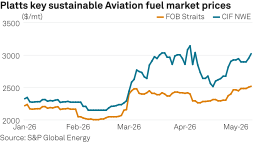
Platts, part of S&P Global Energy, assessed sustainable aviation fuel HEFA-SPK FOB Straits at $2,435/metric ton June 30, up $5/mt from June 29.
