Agriculture, Biofuels, Grains, Oilseeds
June 26, 2026
US finalizes framework linking low-carbon crop practices to biofuels via 45Z credit

Editor:
HIGHLIGHTS
USDA finalizes low-carbon crop credit rules
Mass balance tracking required for premiums
68% of corn farmers use regenerative practices
The US Department of Agriculture finalized a rule June 25 establishing technical guidelines for farmers to quantify and verify carbon intensity reductions from regenerative agriculture practices, creating a pathway for producers to earn premiums by supplying lower-carbon feedstocks to biofuel producers claiming the 45Z Clean Fuel Production Credit.
The regenerative-feedstock rule requires field-level carbon intensity calculations, mass balance chain-of-custody tracking, and third-party verification for corn, soybeans, sorghum and spring canola used in biofuel production, addressing industry demands for defensible carbon accounting as billions of dollars in tax credits hinge on lifecycle emissions reductions.
USDA Secretary Brooke Rollins announced the final rule as President Donald Trump signed an executive order advancing regenerative agriculture, calling the framework "the most significant market-driven effort ever undertaken to reward America's farmers for voluntarily implementing regenerative practices while producing the crops that fuel America's growing bioeconomy."
The rule will be published in the Federal Register June 29, with full technical specifications.
The framework establishes standards for covered biofuel-feedstock crops and participating entities throughout the supply chain, field-level quantification of crop-specific carbon intensity, mass balance chain-of-custody standards including traceability and recordkeeping, auditing and verification requirements, and regenerative-agriculture practice standards for covered feedstock crops, according to the USDA statement on June 25.
USDA released an updated feedstock carbon-intensity calculator to help producers quantify regenerative practices including cover crops, improved nutrient management and conservation tillage.
Producers can use the resulting reports when marketing eligible feedstocks to participating biofuel producers seeking lower carbon intensity scores under 45Z, which provides up to $1.75 per gallon for transportation fuels based on lifecycle greenhouse gas emissions reductions.
Mass balance requirement
The rule requires mass balance tracking rather than book-and-claim accounting, meaning the carbon intensity benefit stays with the physical crop through the supply chain from field to first point of aggregation to biofuel producer, according to Veriflux, a supply chain traceability company.
Entities participating in multiple sustainability programs must provide third-party verifier documentation across all programs to prevent double counting of greenhouse gas benefits, Veriflux said in a June 25 Linkedin statement.
"A reduced-CI bushel is only worth more if everyone downstream can prove it's real," Veriflux said. "The premium only exists if the attribute behind it holds up."
The framework creates opportunities for US biofuel-feedstock producers, with American farmers currently producing approximately 6 billion bushels of corn used annually for ethanol production and 1.8 billion bushels of soybeans for biofuel production, the USDA statement said.
Some 68% of corn farmers already implement at least one regenerative practice, while 70% of soybean farmers utilize at least one such practice.
The rule builds on USDA's regenerative pilot program, which provided $700 million to help farmers adopt practices that improve soil health and water quality.
Under the pilot, USDA completed over 67,000 whole farm conservation plans covering more than 49 million acres and over 1,500 conservation contracts worth more than $200 million, the agency said.
"Instead of mandates, we're creating market opportunities," Rollins said. "Farmers who choose to implement regenerative practices will have new opportunities to earn premium prices, lower their input costs, improve soil health and strengthen the long-term profitability of their operations."
The announcement builds on the Trump administration establishing the highest Renewable Volume Obligations under the Renewable Fuel Standard in US history and Congress extending the 45Z clean fuel production credit, providing producers a pathway to benefit from expanding biofuel markets, the USDA said.
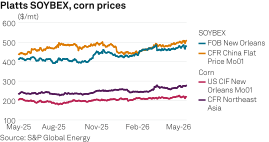
Platts, part of S&P Global Energy, SOYBEX FOB New Orleans for August shipment was assessed at $455.25/metric ton on June 25, up $8.54 from June 24.
