June 25, 2026
As European shrimp demand shifts, Ecuador’s market faces a strategic choice
By Mariana Farhat and Graham Style
Editor:
HIGHLIGHTS
Europe shifts focus to IQF shrimp variety
Ecuador's exports rise but EU share drops
Processing capacity limits value-add growth
As weak demand and abundant global supply continue to pressure margins across the shrimp sector, European buyers are placing greater emphasis on varieties that help reduce waste and improve operational efficiency. One of the main beneficiaries of that trend appears to be individually quick-frozen shrimp, according to market participants.
According to a European importer focused on the food service segment, purchasing decisions are increasingly influenced by kitchen labor availability, portion control, waste reduction, and inventory management. In that environment, buyers are placing greater emphasis on the total cost of using a product rather than simply the purchase price.
"IQF is gaining purchase interest because it helps reduce waste, allows better portion management, and gives customers more control over real usage costs," the importer said. "Years ago, when demand was stronger and consumption volumes were higher, block-frozen products made more sense because high turnover absorbed the format, and waste was less relevant. Today, buyers want more flexibility, more control, and less operational risk."
Cost pressures reshape purchasing decisions
The trend emerges at a time when shrimp markets remain characterized by abundant supply and weak demand growth, with prices reflecting this softer environment. Platts, part of S&P Global Energy, assessed the Ecuadorian head-on shell-on 30-40 count shrimp at $4,400/metric ton on June 25, as a downward adjustment from the stability during the week.
Chinese buyers have repeatedly pushed for lower prices, while importers across major consuming regions report compressed margins and little appetite for inventory accumulation. The main challenge is not a lack of consumption but supply growth consistently outpacing demand growth.
"They are putting a lot of pressure on margins and trying to push prices down, but as producers we have a floor, and we cannot go below that because, in the end, we are all looking for a profit, and it does not make sense for us to sell at a loss," an Ecuadorean producer said.
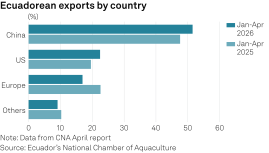
Europe illustrates that imbalance. Data from Ecuador's National Chamber of Aquaculture, or CNA, show Ecuador's shrimp exports reached a record 1.11 billion pounds during January-April 2026, up 13.9% year over year, while export revenue rose to $2.68 billion. However, Europe accounted for 16.9% of Ecuador's shrimp exports during January-April 2026, down from 22.6% a year earlier.
Part of the explanation may lie in changing product preferences. European demand has concentrated on cooked, peeled, and further-processed shrimp, while interest in traditional head-on, shell-on shrimpproducts has weakened. Importers said the distinction is no longer purely geographic but linked to segment type. Many food service operators across the region are prioritizing convenience, standardization, and labor efficiency.
"If the Ecuadoreans would pay more attention to IQF, glazed, bagged products suitable for retail... invest in IQF machines, in freezing lines, in glazing machinery, automatic packaging machines, etc. Then I think they will be pretty successful and be able to compete with Asia," a second European importer said.
Opportunity for Ecuador
For Ecuador, responding to that demand shift through large-scale production of value-added products remains difficult. Processing capacity is already operating near its limits, according to producers, while labor availability continues to constrain expansion.
Unlike Asian suppliers such as India, Vietnam, and Indonesia, which built significant processing industries around retail and food service demand, Ecuador's shrimp sector developed around farming efficiency and high-volume raw shrimp production. Processing infrastructure remains largely focused on basic operations rather than labor-intensive value-added segments.
"In a stronger market with very high consumption, block-frozen products made more sense because rotation absorbed the format and waste was less relevant," the European importer said.
Against that backdrop, the growing preference for IQF may present a more accessible opportunity.
Unlike cooked, breaded or peeled products, IQF does not fundamentally change the product itself. It is primarily a change in format. While investments in freezing technology, packaging and logistics are required, the transition is generally less complex than building additional value-added processing capacity and securing the labor needed to operate it.
That distinction could become relevant as market competition intensifies. As global supply expands and buyers gain access to more sourcing options from origins, differentiation based solely on price becomes more difficult.
This does not necessarily imply a structural shift away from block-frozen shrimp. However, the discussion itself could signal an evolution in how buyers assess value.
Whether this develops into a long-term structural change remains uncertain. Still, the growing attention being paid to format and yield could offer an early indication of how purchasing criteria are evolving across parts of the European shrimp market.
The key question may no longer be solely how cost-effectively shrimp can be produced, but how well it can fit into an increasingly efficiency-focused food service environment.
