June 19, 2026
Record Ecuadorian exports challenge the narrative of weak shrimp demand

Editor:
HIGHLIGHTS
Record exports rise 13.9% despite weak tone
China, US imports surge, Europe falls 14.5%
Supply growth outpaces demand, pressures prices
Weak demand has dominated sentiment in the global shrimp market in recent months. Importers in the US have remained well supplied, European buyers have limited spot interest, and Chinese purchasers have continued to push for lower prices. Throughout June, market participants repeatedly described demand as cautious, inventories as elevated, and buying activity as largely limited to immediate requirements.
The weak tone has weighed on prices. Ecuadorian head-on, shell-on shrimp values fell from $4,700/metric ton FCA Guayaquil at the start of June to as low as $4,300/mtbefore recovering modestly amid tighter availability of larger sizes, Platts, part of S&P Global Energy, data showed. Even during the rebound, participants continued to characterize demand as stagnant and resistant to higher prices.
However, Ecuadorian export data tells a different story.
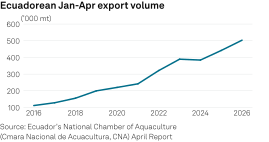
Despite persistent concerns over consumption, Ecuador's shrimp industry continues to ship record volumes into global markets. Exports reached 1.11 billion lb during January-April, up 13.9% year over year, according to data from Ecuador's National Chamber of Aquaculture, or CNA. Export revenue also increased 13.9% to $2.68 billion.
April alone set a new record for the month, with exports rising 17.7% year over year to 298.7 million lb, according to CNA data.
The apparent contradiction suggests the market may be facing a supply problem rather than a demand collapse.
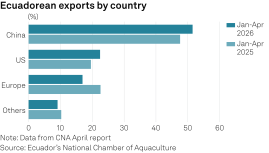
Consumption has not disappeared, but demand growth has remained uneven across regions. China imported 571.4 million lb of Ecuadorian shrimp during January-April, up 23.4% year over year, increasing its share of total exports to 51.5%, according to CNA data. Shipments to the US climbed 30.7% to 249.1 million lb, accounting for 22.5% of exports.
Oversupply is the main challenge
However, Europe moved in the opposite direction.
Exports to the region fell 14.5% year over year to 187.9 million lb during the first four months of 2026, according to CNA data. Shipments declined across key destinations including Spain, France, Italy, Portugal and Belgium.
The decline reflects a structural shift already visible in European buying patterns. Market participants said demand has increasingly concentrated on value-added products such as cooked, peeled and further-processed shrimp, while interest in traditional head-on shell-on products has weakened. As a result, export growth has failed to generate stronger pricing power.
Throughout June, exporters reported abundant availability and continued difficulty clearing volumes without price concessions. Elevated inventories in the US, weak replenishment needs in Europe and persistent pressure from Chinese buyers contributed to a market where sellers were forced to compete aggressively to move product. Additional competition from India and Indonesia further expanded sourcing options for importers.
The recent recovery in larger shrimp sizes has done little to alter the broader market balance. Participants attributed the gains in 20-30 and 30-40 count shrimp primarily to temporary supply tightness caused by seasonal production conditions in Ecuador and reduced availability in competing origins, rather than stronger demand.
For the market, the implication is significant. Record exports suggest global demand continues to expand, but not fast enough to absorb growing supply from Ecuador and other major producers. As long as production growth outpaces consumption, rising export volumes may continue to coexist with weak prices.
In that sense, Ecuador's latest export records are not evidence of a booming market. Instead, they highlight the imbalance that continues to define the global shrimp sector: demand is growing, but supply is growing faster.
