Agriculture, Chemicals, Biofuels, Solvents & Intermediates
June 19, 2026
INTERVIEW: European non-fuel ethanol sector fearing Mercosur impact, fuel sector eyes E20 push

By Sam Faulds
Editor:
HIGHLIGHTS
Chemical quota threatens domestic European producers
Fuel ethanol sector seeks to build momentum on E20 push
Persian Gulf war drives up production and freight costs
The European non-fuel ethanol market is likely to be reshaped by the EU-Mercosur trade agreement, while the fuel sector is ramping up its push for E20 blending, Hubert de Biolley, secretary general of industry association iEthanol, told Platts in an interview at the Dropet European Biofuels Conference in Portugal.
The EU-Mercosur trade agreement continues to dominate discussion in the non-fuel market, with European and Brazilian market participants seeking clarity on both the application of the ethanol quotas and their impact on the European market.
The Mercosur trade bloc, comprising Argentina, Brazil, Paraguay, Uruguay and Bolivia, agreed its largest-ever trade deal with the EU in December 2024, following 25 years of negotiations, with pro-rated quotas activating on May 1, 2026.
For non-fuel ethanol, the agreement includes a duty-free quota of 450,000 metric tons/year for chemical use, phased in over six equal stages annually. A separate ethanol quota for all uses, including fuel, totals 200,000 mt/year, once fully implemented.
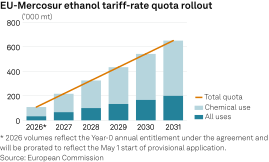
However, quotas are yet to be booked, as players are awaiting clarity on which countries within Mercosur, as well as producers in Brazil, will be allocated the quotas. Brazilian market participants expect sugarcane ethanol quotas to be directed primarily toward producers in the country's North-Northeast, mirroring long-standing sugar export policies. However, grain-based ethanol remains eligible regardless of the producing region.
The scale of the quota relative to the European market is expected to impact domestic non-fuel producers despite EU safeguards. An undercut price of 5% per product, together with a 5% increase in preferential import volumes over an average of three years, or a 5% drop in import prices, would prompt an investigation for a potential suspension of products for that market.
"It's a death warrant," said de Biolley on the impact on the European domestic market. "It will become a Brazilian market."
"If you have nearly half a million [cubic meters] at 30% cheaper, it will become the market. You can't trigger the safeguards efficiently over 10 years, because the market will already be there. So, you can't prove that there is an increase of X percent or a decrease in market price."
"One medium-range vessel of 50,000 [cu m] is more than most [European plants'] production. You are cooked."
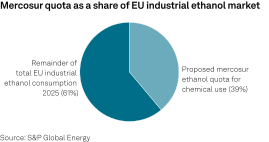
With the non-fuel market, the eventual 450,000 mt quota would have represented 39% of total EU industrial ethanol consumption in 2025, according to S&P Global Energy Horizons data.
The European fuel ethanol sector continues to advocate for a 20% ethanol blend in gasoline, with the issue becoming more prominent since the war in Iran. The current maximum blend across most of Europe is 10%.
In an April letter to three MEPs, European Commission President Ursula von der Leyen said the commission would consider authorizing a higher E20 ethanol blend as part of the revision of the policy framework for fuels.
However, no timeline was stated, and policy considerations were raised over "problems related to the suitability of engines of existing vehicles for this fuel, as well as the need to incentivize investment in advanced biofuels."
A push for first-gen E20 remains the sector's focus, with advanced second-gen supplies already tight.
"You can't supply E20 with waste, there's not enough raw material. The industry for 80 years has suppressed waste," de Biolley said.
RED III legislation has increased mandates for advanced fuels such as ethanol to 2030. However, the removal of double-counting incentives in key markets has shifted demand from blenders in markets such as Germany towards HVO and tickets, as well as high-GHG-saving first-gen ethanol.
"The problem is that suppressing double counting, moving to greenhouse gas [emissions-based], and asking to increase advanced; it doesn't go together,"
"The solution is E20; we can supply tomorrow if we move to step up. With the right push, we could [get approval] within a year."
Despite previous reluctance, European car manufacturers are also now on board. The European Automobile Manufacturers' Association, the European Association of Automotive Suppliers CLEPA, and Germany's Association of the Automotive Industry were among the signatories of an open letter to the commission dated June 9 calling for E20.
Von der Leyen's letter came in the same month as the AccelerateEU communication, aimed at assuring European energy security and reducing dependence on foreign energy.
The E20 push in Europe has become more prominent in light of the Iran war and rising fuel costs, but continues to face opposition from the food versus fuel debate.
According to a study published June 4 by Transport and Environment, escalating global biofuel mandates risk deepening food insecurity and fertilizer shortages triggered by the Middle East crisis. It warns that if proposed blending mandates are fully implemented, global biofuel demand could surge 70% by 2030, intensifying competition for crops, fertilizer and farmland at a time when supply chains remain disrupted by the closure of the Strait of Hormuz.
iEthanol argues that modern ethanol production yields more than fuel, with improved productivity enabling food, feed and fuel outputs to grow together without additional land.
E20 could generate an additional 3.2 billion liters of ethanol demand in Europe under a conservative adoption scenario by 2030, rising to a trebling of current supply volumes if the full petrol pool moves to E20, according to a supply and demand study commissioned by ethanol association ePure from consultancy E4tech.
A greater need for fuel imports could also create a stronger incentive to shift the Mercosur quota towards fuel-grade imports, thereby providing relief to the non-fuel sector.
Impact of the war in Iran
Since the start of the war in Iran, European ethanol producers have faced rising production and freight costs.
European natural gas markets saw welcome but limited relief from the US-Iran deal, remaining about 30% higher than at the start of the war. Non-fuel prices saw a rise to April driven by rising transport costs and have since reached a ceiling, according to market participants across Europe.
Despite non-fuel grades flipping to a discount against fuel grades in April, de Biolley noted the backwardated fuel market is limiting knock-on impacts to non-fuel.
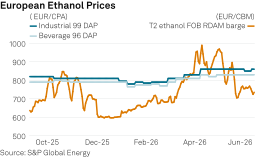
Rectifiers, which use fuel-grade ethanol as feedstock rather than distilling from grains, are to reduce the impact by hedging using the T2 fuel paper contract.
With much of the non-fuel market supplied on a three-to-six-month contract basis, de Biolley noted that the non-fuel market is correlated to fuel by around by six to nine months.
"You carry a risk in non-fuel because you can't reposition. Fuel is very liquid."
Platts is part of S&P Global Energy.
