Agriculture, Energy Transition, Refined Products, Biofuels, Renewables, Jet Fuel
June 19, 2026
ANA extends SAF program to individual passengers in Japan first

Editor:
HIGHLIGHTS
ANA launches SAF program for individuals
Program lets passengers offset flight emissions
Japan warns SAF shortage threatens economy
All Nippon Airways has launched a program that lets individual passengers purchase sustainable aviation fuel credits tied to their flight emissions, becoming the first Japanese carrier to extend such carbon-reduction initiatives beyond corporate clients as airlines race to secure SAF amid warnings that delays threaten Japan's economic security.
Rolled out June 18, the Personal Program under ANA's SAF Flight Initiative allows travelers to buy "SAF environmental value" corresponding to CO2 emissions from specific flights. Proceeds will fund expanded use of SAF across the carrier's operations. The expansion comes less than a month after ANA and Japan Airlines jointly warned that SAF shortages could prompt international carriers to bypass Japan as a destination.
ANA partnered with Norwegian climate technology company Chooose to provide a platform that visualizes flight-specific CO2 emissions and enables the purchase of SAF credits. Passengers select their route and cabin class, choose the percentage of emissions to offset, and receive a certificate specifying the CO2 reduction amount after payment.
Broadening participation
Pricing is based on route, service class and the percentage of emissions passengers choose to offset. Transaction fees cover platform operating costs. Chooose issues receipts and purchase certificates, which are simpler than the third-party certified CO2 reduction certificates offered under ANA's existing corporate and cargo programs. ANA said third-party auditors regularly review SAF inventory and allocation to prevent double counting.
SAF can reduce life cycle CO2 emissions by about 80% compared with conventional jet fuel. However, as of 2025, production represented only about 0.6% of the global jet fuel supply, according to the International Air Transport Association. Limited availability has made adoption challenging, with domestically produced SAF in Japan costing three to five times as much as conventional jet fuel.
ANA's SAF Flight Initiative previously offered a Corporate Program for business travel and a Cargo Program for shippers seeking to reduce transportation emissions under Scope 3 greenhouse gas accounting.
As of March 2026, 358 companies and organizations had joined ANA's and JAL's combined corporate SAF programs. ANA said expanding to individual passengers provides more options for customers who want to support aviation decarbonization.
The ANA Group has committed to achieving net-zero CO2 emissions from aircraft operations by 2050. The carrier has pursued multiple SAF initiatives, including using SAF on trans-Pacific flights starting in 2012 and establishing supply agreements with producers, including Finland's Neste and Japan's Cosmo Oil Marketing.
In their May 27 joint report, ANA and JAL proposed a "transparent, fair and uniform" cost-sharing framework in which airlines would bear a portion of the price differential between SAF and conventional fuel, while government support and user contributions would cover additional costs. The carriers warned that if Japan fails to secure adequate SAF supplies, the country risks being bypassed as a destination or transit point by international carriers.
The airlines noted that air transport in Japan generates an economic ripple effect of about 7 trillion yen annually, equivalent to 2.8% of gross domestic product.
They said maintaining stable fuel supplies is essential for achieving the government's target of 60 million visitors to Japan by 2030 and for preserving air links to remote islands and rural areas.
Mass production of domestically produced SAF in Japan is expected to begin about 2030, with government support already in place. However, the carriers said immediate action is required to ensure adequate supply and avoid the enormous social costs that would result from failing to meet 2050 targets.
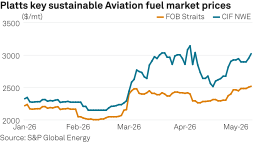
Platts, part of S&P Global Energy, assessed sustainable aviation fuel HEFA-SPK FOB Straits at $2,395/mt June 19, unchanged from June 18,
