Agriculture, Grains
June 17, 2026
Wheat markets shrug off US-Iran deal as freight, harvests take focus
Editor:
HIGHLIGHTS
Harvest, weather drives Black Sea, Australia focus
Freight costs expected to decline
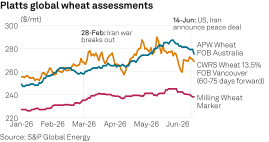
Global wheat markets showed only limited weakness after the announcement of a tentative US-Iran peace deal and its potential to reopen the Strait of Hormuz. Traders said they expect the biggest impact to be lower freight costs rather than a sharp drop in wheat origin prices.
Market participants across the Black Sea, Australia and North America said wheat prices remain mainly driven by harvest, weather, currency and demand. The peace deal comes after geopolitical risk had briefly lifted freight and origin prices, on concerns about disrupted fertilizer and fuel supplies.
Markets are now watching whether easing war-risk premiums and weaker crude oil translate into cheaper ocean freight, which could further pressure delivered wheat values.
In the Black Sea, traders said the peace deal is unlikely to significantly impact wheat prices in the near term. The market's attention has shifted to the upcoming new-crop harvest, which is expected to begin next month.
Russian traders are monitoring heavy rains in southern Russia, which could delay the new harvest. One Russian seller said there was an "80% chance of delays in July," which could push prices higher if loading schedules tighten.
Sellers have already been lowering offers amid positive new-crop expectations, large carryover stocks and weak demand from key importers. The Platts wheat benchmark, Milling Wheat Marker, has eased since early June, falling from $242.25/metric tons to $238/mt as of June 16.
Demand from major destinations such as Egypt, Morocco and Turkey has also been limited. Turkey is expected to have a large domestic crop, while Morocco and Egypt are holding comfortable stocks. That has reduced buying urgency and weighed on CIF values. Platts CIF East Mediterranean 12.5% wheat was assessed at $256/mt, down from $261/mt at the start of June.
On freight, traders said Black Sea-to-Egypt freight briefly rose after the Iran conflict began, reaching around $27/mt, but has since softened amid lower demand and reduced risk premiums. Any further decline amid the peace deal could keep delivered prices under pressure.
"If all macros go down, wheat prices might follow," one trader said, of the potential impact of weaker oil and broader commodity markets.
Currency, weather key price drivers for Australia
In Australia, weather developments and new crop prospects are expected to remain the major drivers of Australian wheat prices in the near term, according to several Australian trade participants, with limited impact anticipated from the peace deal announcement.
Australian Premium White rose $1/mt on the day to $276/mt, while Australian Standard White with no protein guarantee rose $1/mt to $271/mt June 17.
Two Australian trade sources said CFR offers would see a greater reprieve compared to FOB offers tracking weaker crude oil prices and, consequently, freight rates, though an upcoming Black Sea harvest would still make it challenging for Australia to compete in the near term.
"Despite a late-May commodity sell-off triggered by US-Iran peace hopes, Australian cash wheat prices remain driven by local supply and demand rather than global macro events. For old crop, a softening in freight rates presents a minor headwind, but the Russian harvest and exports will ultimately set the price direction during this seasonally uncompetitive period for Australian wheat," said Vladimir Zinkovski, associate director and head of Asia-Pacific crops at S&P Global CERA.
"For new crop, key signposts include the resumption of nitrogen and feedstock imports alongside critical August–September rainfall, though strong current soil moisture buffers potential El Niño risks and points toward improved liquidity ahead," Zinkovski added.
North American traders remain cautious
Canadian and US wheat market participants reported cautious reaction from the market following the US-Iran trade deal, with many still skeptical on its longevity.
"So many faints, tough to know if this will stick," a Canadian trader said. "I think most will take a wait-and-see approach."
No immediate impacts were heard on cash prices, with Platts Canadian Western Red Spring wheat 13.5% protein FOB Vancouver 30-45 days forward assessed at $268.60/mt June 16, only $2.57/mt lower than June 12, before the deal was announced.
Despite no immediate market repercussions, downward pressure on prices in the long term was anticipated by some participants, particularly on freight rates.
"I suspect ocean freight will continue [a] long and slow decline," a US trader said. "It was inflated by about $8/mt into [the] far east after the war. So, these need to be given back."
The Canadian trader shared a similar view, speculating freight declines amid lowered war risk.
"I think [we] would see the liners being a little more receptive to putting trades on without a bunch of protection," he said, adding, "the lower the risk, the more willingness to negotiate the rates."
