Agriculture, Grains
June 17, 2026
Ukraine corn prices slide as demand from key buyer Turkey fades

Editor:
HIGHLIGHTS
Ukraine corn prices drop $11/mt on weak demand
Turkey imports slow as wheat, barley compete
European demand limited; prices face pressure
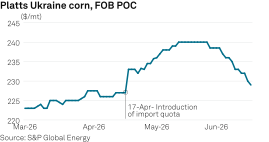
Ukrainian corn prices are down $11/metric ton month over month as demand from Turkey, the country's key buyer, weakened following an earlier rally sparked by an import quota.
Platts, part of S&P Global Energy, assessed Ukraine corn FOB POC at $229/mt on June 16, down from $240/mt on May 15.
"At current Chicago levels, Ukraine calculates only to Turkey, and that demand is not enough," a Ukrainian seller said.
Turkey has been the leading destination for Ukrainian corn so far in the 2025-26 marketing year. According to port line-up data shared by a trader, Turkey imported 4.8 million mt of Ukrainian corn from September through May, accounting for about 30% of Ukraine's total corn exports during the period.
Prices initially rallied after Turkey introduced a corn import quota on April 17. The measure opened a 3 million mt tariff quota for corn imports, with a reduced customs duty of 5%, for the period from April 20 to July 31. Following the announcement, Ukrainian corn prices climbed to a nine-month high, with Platts assessing Ukraine corn FOB POC at $240/mt on May 13, up from $227/mt on April 17.
However, the rally lost momentum as demand from Turkey's feed industry -- the country's main corn consumer -- weakened. Turkish importers said competitively priced wheat and barley have reduced corn demand in feed production.
"Corn consumption has come down, and most feed producers will change their ratios toward feed wheat as the harvest has started," a Turkey-based importer said. "There is also the cost of finance, which is high. It doesn't mean the quota has to be fulfilled."
Importers said more than half of Turkey's corn import quota has already been used. "If CIF Turkey prices fall further, the full quota can be used," a Turkish importer said. "If not, feed factories will use domestic barley from their regions."
Still, some market participants expect Turkish corn demand to re-emerge later in the season, driven by delays in the domestic corn harvest.
"The corn harvest will be delayed in Turkey because rain has delayed planting, so there will be a two-month gap between the end of the quota and the corn harvest," a Turkish feed producer said. "Feed factories close to the ports are somewhat far from the main barley harvest areas. Barley may affect corn consumption, but it will not replace corn one-for-one. There will also be a surplus of feed-grade wheat, but it must be priced as cheaply as corn to replace it."
Demand from Europe limited
Moreover, Turkish authorities on June 12 appointed temporary administrators for 13 major poultry companies as part of an investigation into alleged violations of competition law, unjustified price increases and consumer harm. The move weighed on sentiment in the poultry sector, one of Turkey's largest corn-consuming industries.
"Poultry companies received only fines, but there is still no demand," a Turkey-based broker said.
With Turkish demand slowing, Ukrainian sellers have lowered their prices to remain competitive with other destinations, particularly Europe. However, demand there has also been limited.
In Italy, demand in the feed sector remains slow, market participants said. "Some industries report their inventories one month later because of slower feed usage for animals," an importer said. "Since the war started, retail consumption has dropped dramatically -- meat, eggs, poultry, flour-mill semolina and other products are down by 20% over the last two months."
In Spain, traders said South American corn remains more competitive than Ukrainian origin. "South American corn is calculating cheaper everywhere," a Geneva-based trader said.
Despite weaker nearby demand, Europe remains an important outlet for Ukrainian corn. According to port line-up data shared by a trader, Italy, Spain and the Netherlands together accounted for 32% of Ukraine's total corn exports from September through May in MY 2025-26.
Traders expect Ukrainian corn prices to remain under pressure amid strong new-crop production prospects and lower CPT prices, unless Turkey returns with another round of buying before the quota expires on July 31.