Agriculture, Grains
June 17, 2026
Global corn prices fluctuate on uncertainty ahead of US-Iran peace talks
Editor:
HIGHLIGHTS
Asian, EMEA buyers await freight clarity
US market skeptical of peace deal odds
Brazil eyes 5-8 mil mt Iran demand post deal
Global corn prices fluctuated June 17 ahead of an expected signing of a peace deal between the US and Iran June 19, as market participants maintained a wait-and-see approach amid uncertainty over details of the deal.
Asian buyers on sidelines
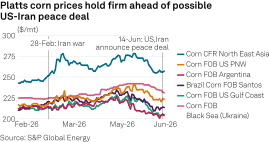
Asia corn prices were firmer across the week, with the Platts CFR Northeast Asia assessment rising $3/metric ton from June 12 to $259/mt June 17. Platts is part of S&P Global Energy.
In Vietnam, feed millers remained on the sidelines ahead of June 19, as they "expect a drop in ocean freight ... and set a new low target; expecting low $250s/mt CFR for August and September shipment while the traded prices in the previous week was mid-to-high-$250s/mt."
"We saw many times how the deal fell through, so now market participants don't believe [information on a peace deal] easily," said a Singapore-based trader.
"Given the current stance, unless another missile flies over to Iran, freight is more or less stable until the Friday signing, that is what I hear from freight owners," said a second Singapore-based trader.
Rates from South America and the US to Asian destinations saw a "gradual drop" of "about $2/mt since last Friday," according to a grains trader that offered corn to Vietnam.
EMEA buyers await clarity
Corn buyers in Middle Eastern countries are taking a wait-and-see approach, with traders saying the impact of recent developments will become clear only after the deal is signed.
In Saudi Arabia, importers expect corn shipments to return to Dammam after the route was shifted to Jeddah following the conflict.
"When Hormuz starts opening, we will take everything to Dammam," a Saudi importer said.
"The impacts are not yet seen. We still need to know if vessels will go in or not. We are awaiting the signing on Friday," a UAE-based trader said. The trader added that, with the UAE serving as a major transshipment hub for corn to other Middle Eastern countries, trade flows will depend heavily on the reopening of routes.
In Egypt, traders said the main impact would be on the exchange rate of the Egyptian pound, which could influence the local market.
"The market in Egypt is now under very high-pressure as the Egyptian pound is recovering after the war ends," an Egyptian trader said. "That is not a very good scenario for selling corn, as local prices keep going down."
In the Black Sea market, corn prices were falling amid weak demand. Sellers said lower fuel prices could encourage farmers to increase crop sales.
"If Ukrainian farmers see lower prices at gas stations, they might consider selling their crop at lower prices, but we're not there yet," a Ukrainian seller said.
Platts assessed Ukraine corn FOB POC at $229/mt June 17, up $7/mt from Feb. 27.
US prices ease
US corn prices have been closely tied to the energy market, and sources said the potential peace deal has eased some pressure, but volatility remains high.
"With the potential for the war to be over, anyone who was buying corn because of energy would be exiting that position, because of the risk of higher inflation," said a trader source.
The Chicago Board of Trade corn futures for July (N) and September(U) contracts decreased, which moves Platts outright prices.
Platts assessed the outright price for FOB Gulf corn at $204.92/mt June 16, below $8.66/mt from Feb. 28. The highest price since the beginning of the conflict was $226.08/mt May 1.
"US corn is starting to lose demand to South American supply coming onto the market, which is normal for this time of year," a trader source said.
Latin America market split
A potential peace deal led some market participants in Latin America to expect a rebound in international demand, while others said it would not change the dynamics of Brazil's corn market.
According to a broker, during the conflict, the expectation was that Iran would import a relatively small volume of Brazilian corn. Now, discussions point to 5 million-8 million metric tons if the deal is reached, which could lift prices in the last quarter of the year as domestic market availability in Brazil tightens.
On the other hand, a trader said they do not believe a deal would benefit Brazil, as internal incentives would likely be introduced to close the gap between international and domestic prices and support liquidity in Brazil's domestic market.
Argentina market participants expected no significant impact, since the country exports a low volume of corn to Iran, the broker said.
Platts assessed FOB Santos corn for August shipment at $213.57/mt June 16, down 10 cents/mt day over day. Platts assessed FOB Up River corn for August shipment at $199.80/mt June 16.
