Agriculture, Grains, Biofuels, Oilseeds
June 17, 2026
Biofuels remains critical demand catalyst for agriculture amid structural surplus risk

Editor:
HIGHLIGHTS
Biofuels offset agricultural surplus risks
US ethanol demand faces 50% drop by 2050
SAF and marine fuels offer growth potential
Global agriculture is entering a period of structural transformation that poses significant risks to farm incomes, crop acreage, and rural economies — risks that biofuels are uniquely positioned to offset, a report said June 16.
The report, Fueling Agriculture: Biofuels as the Catalyst by S&P Global Energy for US Farmers & Ranchers in Action (USFRA), warns that food demand growth is decelerating alongside slowing population growth and moderating per capita consumption, while agricultural productivity continues to break records. Global grain, oilseed, and fiber stocks hit nearly 1 billion metric tons in 2025, as world corn yields have grown at 1.5% per year over the past decades.
Ethanol demand under pressure
Biofuel demand, particularly ethanol in road transport, is under mounting pressure from EV penetration, vehicle efficiency gains, and stagnating blend policy. At the current 10% US blend rate under the Renewable Fuel Standard (RFS), US ethanol demand for on-road transportation could fall nearly 50% to roughly 6.6 billion gallons by 2050.
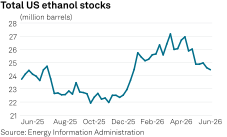
The consequences for agricultural land are stark. With about 36% of US corn acreage currently tied to ethanol production, a failure to expand blend rates could see US corn growers cultivating roughly 31% fewer acres by 2050 equivalent to halting production across an area the size of North Carolina.
Policy driving soybean crush
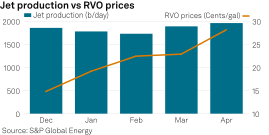
On the oilseeds side, rising RFS Renewable Volume Obligations (RVOs) for biomass-based diesel have driven a 480-million-bushel (20%) increase in domestic US soybean crush capacity since 2022.
The US EPA's March 2026 RVOs signal a further ramp-up of biomass-based diesel from 5.42 billion gallons in 2025 to 8.95 billion gallons by 2027, with the agency also signaling a preference for US-origin feedstocks, the report said.
"Now that we have biodiesel and renewable diesel, about half of the value of soybeans comes from the oil once something we barely paid attention to due to limited demand," said Tim Ostrem, director at the United Soybean Board in report.
Globally, biofuels represent just 3.2% of total liquid petroleum demand, with road gasoline blends at 7.5% and diesel at 5.9%, while SAF penetration sits at just 0.8% and marine fuels at effectively zero underscoring the scale of market potential.
SAF, Marine Open New Feedstock Frontiers
The study highlights aviation and marine fuels as largely untapped growth vectors. SAF from bio-based feedstocks remains one of the few viable pathways to reduce aviation emissions at scale, while ethanol is identified as an affordable option for decarbonising marine heavy fuel oil. Even modest blend mandates in these segments could generate meaningful new demand for agricultural feedstock.
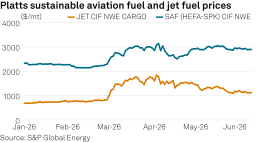
Under an optimized scenario — driven by policy incentives, technology adoption, and market signals — global ethanol output from corn, sugarcane, and other feedstocks could grow by 300% to 140 billion gallons by 2050, while soybean oil and canola-based HEFA biofuel feedstocks could expand by 169% to 23 billion gallons.
Technology holds the key
The report emphasizes that realizing this potential is not primarily a technical challenge but an economic one. Under an optimized yield scenario, US corn yields could grow at a 1.6% compound annual rate through 2050 — above the historical 1.2% trend — driven by advanced seed technologies, AI-enabled breeding, gene editing, precision agriculture, and regenerative practices. US corn output could increase nearly 50% by 2050 without any net change in cropland.
However, adoption of precision tools remains low: variable-rate fertilizer application has been adopted by only 40–45% of US producers, while cloud-based farm data platforms are used by just 20–30% of farms, according to the 2025 Purdue University Precision Agriculture Dealership Survey cited in the study.
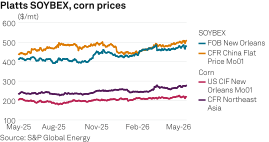
"History shows that farmers can scale production, and continued technological innovation allows them to do so more efficiently. If demand signals return, we're confident even more technology will be adopted and supply will follow," said Josh Garetson, John Deere Renewable Fuels & Corporate Strategy Director.
Co-products strengthen food-fuel nexus
The study challenges the traditional food-versus-fuel framing, noting that biofuel production generates protein meals and DDGS that are reintegrated into the food system.
Under the optimized scenario, food and feed supplies across selected countries are projected to be 45% higher by 2050 compared with 2025, potentially easing input costs and improving food affordability globally while simultaneously supporting a much larger biofuel industry.
CI incentives reshape landscape
The study notes that policies like the US IRA's Clean Fuel Production Credit (Section 45Z) mark a shift from volume-based mandates toward carbon-intensity (CI) frameworks, directly rewarding farmers for climate-smart practices such as no-till, cover crops, and efficient fertilizer use. US ethanol CI has been declining for decades, and further reductions are possible through 100% renewable electricity, renewable natural gas, carbon capture, and climate-smart agriculture.
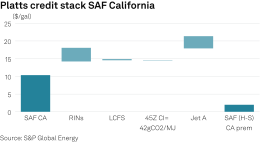
Platts, part of S&P Energy, assessed SAF California at 987.75 cents/gal and SAF (H-S) CA (credits det) at 495.86 cents/gal June 16.
Platts assessed ATF 30/70 CA at 539.02 cents/gal. This reflects a premium of 233 cents/gal to Jet Kero Los Angeles CA Pipeline, tracking an indicative premium of 233 cents/gal to Jet Kero Los Angeles CA Pipeline.
