Agriculture, Sugar
June 16, 2026
Indian sugar trade houses seek policy overhaul after export ban, propose EU-style auction system

Editor:
HIGHLIGHTS
Sugar industry proposes EU-style auctions
Quarterly quotas aim to prevent sudden bans
Export ban damages India's global reputation
India's sugar industry is calling for quarterly export quotas and a European Union-style auction mechanism to prevent trade disruptions caused by sudden export bans, as the country seeks to balance domestic supply priorities with maintaining its credibility as a reliable supplier in global markets.
The government should engage exporters through a structured quota system rather than imposing overnight bans that damage India's reputation and leave traders with compliance issues and foreign-exchange losses, Rahil Shaikh, managing director at MEIR Commodities, said at the Sugar, Ethanol and Bioenergy conference in Mumbai on June 12-13.
"The biggest loss is the face-value loss," Shaikh said. "The markets we create in the world market take a lot of time to build a reputation as a buyer, as a brand, as quality. This sudden stopping harms our reputation in such a way that rebuilding this exercise is going to take a long time."
The comments come after India imposed an export ban, disrupting contracts with key markets including Sri Lanka, Afghanistan and Djibouti. The ban marked the seventh such restriction since 2005, according to Shaikh.
India's Directorate General of Foreign Trade imposed a ban on sugar exports, effective immediately through Sept. 30. Market participants said the ban is likely to remain in place through the 2026-27 marketing year,as the country prioritizes domestic supply and ethanol production amid crop concerns linked to El Niño weather patterns.
Policy alternatives
Industry executives proposed two mechanisms to reduce trade disruption while maintaining government control over export volumes.
The first approach mirrors the EU restitution quota system, where the government auctions export rights weekly or monthly. Under this model, if domestic sugar trades at Rupee 36/kg and international markets at Rupee 50/kg, exporters would pay the Rupee 14/kg differential to the government, which could redistribute proceeds to quota holders.
"There is absolutely no loss, no engagement, and you can buy the best quality sugar to export at the best price," Shaikh said.
The second mechanism involves quarterly quota releases rather than annual allocations. This would allow the government to adjust export volumes in line with evolving crop estimates while providing traders with sufficient visibility to execute contracts.
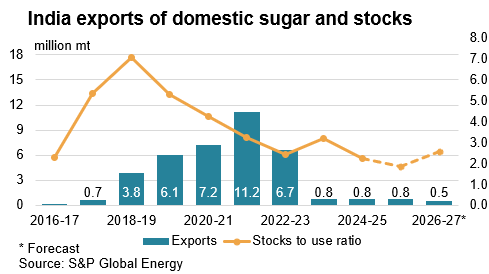
"Give 0.5 million metric ton for the first quarter, let it complete, then come up with the second tranche," Anshul Sharma, head of sugar desk at Reliance Retail, said at the conference. "It will give confidence to the exporters and trade houses."
The quarterly approach addresses a core problem: India's sugar production estimates have shifted dramatically in recent years, from 33 million-34 million mt to 28.3 million mt, making annual export commitments difficult to sustain.
Sharma criticized the government's decision to approve an additional 0.5 million mt of exports in March before imposing the ban in May. "On one side, you are saying go ahead and export, and overnight you are taking a call to ban," he said. "The impact on trade houses and exporters is very large. Their values are at stake."
The ban had minimal impact on global sugar prices, which fell 2 cents/lb after the announcement, underscoring India's limited role as a swing supplier. However, the reputational damage to Indian exporters may require price discounts to rebuild buyer confidence when exports resume, Shaikh said.
"When the next export announcement comes, we will be doing short-term business rather than long-term business," Shaikh said.
Similar wheat and rice bans in past
Beyond sugar, India has imposed similar restrictions on wheat and rice exports since 2022, creating parallel disruptions in grain markets. Rajesh Jain, chief manager at KRIBHCO Agri Business, said India lost 14%-15% market share to Pakistan, Cambodia and Vietnam following rice export bans.
"The importing countries who were importing from us started growing paddy themselves," Jain said, citing Burkina Faso and Nigeria as examples. "Although the cost of their paddy is three times in comparison to what India produces, it has been a replacement."
The export window for Indian sugar is likely closed for 24 months based on supply-demand fundamentals, Shaikh said. India's sugar production is expected to rise 8.2% year over year in the 2026-27 marketing season to 30.21 million mt from 27.93 million mt, according to S&P Global Energy CERA. However, estimates could shift depending on El Niño's impact.
The diversion of sugar for ethanol production in the 2025-26 marketing season is estimated at 3 million mt, according to industry participants and CERA data.
Industry executives urged policymakers to consult exporters before implementing trade restrictions and to use technology to improve crop forecasting accuracy.
"Government should engage with the industry to understand the pulse and market reputation that exporters are globally making," Jain said. "They need a consistent policy for at least two to three years."
Platts assessed hydrous ethanol ex-mill Ribeirão Preto converted into raw sugar equivalent at 13.33 cents/lb on June 10. The July NY11 sugar futures contract settled at 13.92 cents/lb on June 10.
