Agriculture, Oilseeds, Vegetable Oils
June 16, 2026
Funds remain heavily bullish on soybean oil as July/Dec inversion nears 2022 levels

Editor:
HIGHLIGHTS
Funds hold 131,436 net long soybean oil contracts
South American supplies remain ample amid rally
Managed Money traders remained heavily bullish on soybean oil as of June 9, holding a net long position of 131,436 futures and options contracts despite liquidating nearly 25,000 contracts of net length during the reporting week, according to the latest Commitments of Traders data from the US Commodity Futures Trading Commission.
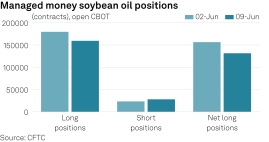
The latest Disaggregated Commitments of Traders report showed Managed Money held 159,380 long positions and 27,944 short positions in soybean oil futures and options combined as of June 9. The resulting net long position remained historically elevated despite a sharp correction in soybean oil futures from recent multiyear highs.
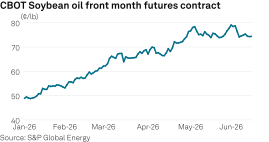
The positioning adjustment came after CBOT July soybean oil futures fell from 78.41 cents/lb on June 2 to settle at 74.91 cents/lb on June 9, a decline of 4.5% during the reporting period. Market participants attributed the correction to favorable US crop conditions, the absence of confirmed Chinese soybean purchases and profit-taking by speculative investors following one of the strongest rallies across the agricultural commodity complex this year.
Managed Money leads the liquidation
The group's net long position declined by about 25,000 contracts, or about 16%, compared with more modest changes among Producer-Merchant, Swap Dealer and Other Reportable accounts. Market participants said the scale of the reduction provides strong evidence that speculative liquidation was a major driver behind the decline in soybean oil futures between June 2 and June 9.
Despite the reduction, Managed Money remained net long 131,436 contracts as of June 9, representing more than one-sixth of total soybean oil futures and options open interest. Traders noted that such positioning remains historically elevated and is comparable to levels seen during major soybean oil bull markets, including the global vegetable oil rally of 2021-22, underscoring that speculative investors continue to maintain a strong bullish bias toward the market.
The composition of the position change is equally important. The reduction in bullish exposure reflected a decline of 20,257 long positions alongside an increase of 4,740 short positions compared with the previous week, indicating that the correction was driven primarily by long liquidation rather than aggressive new bearish positioning.
"The correction reduced some of the excess enthusiasm, but funds are still positioned for a constructive soybean oil market," one Brazil-based soybean oil trader said. "The renewable diesel story has not gone away."
Market participants continue to point to expanding renewable diesel production capacity, proposed increases to biomass-based diesel blending requirements and implementation of the 45Z clean fuel tax credit as key drivers of domestic soybean oil demand growth.
Strong inversion signals tight nearby supplies
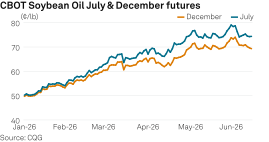
The CBOT July/December soybean oil spread widened to nearly 6 cents/lb during late April through early June, reaching one of the strongest inverse structures seen in recent years and approaching levels last observed during the global vegetable oil market disruption of 2022.
An inversion, in which nearby futures trade at a premium to deferred contracts, is generally viewed as a signal of tight nearby supply.
The July contract largely reflects remaining old-crop soybean oil inventories available before the US soybean harvest, while the December contract reflects expectations for newly harvested supplies later in the year.
Market participants said the widening inversion reflected strong demand for nearby soybean oil driven by renewable diesel production, while expectations for larger soybean crops and expanding crush capacity continued to weigh on deferred contracts.
The structure has discouraged storage and encouraged immediate movement of soybean oil into domestic consumption channels, contributing to tighter nearby availability.
While current spreads remain below the extremes recorded in 2022, traders said the comparison remains relevant because both periods featured strong nearby demand colliding with constrained short-term supply availability. Unlike 2022, however, the current tightness appears concentrated primarily within the US domestic soybean oil market rather than across the broader global vegetable oil complex.
South American export markets remain well supplied
While speculative investors remain heavily bullish on soybean oil futures, physical export markets in South America continue to reflect a much more comfortable supply environment.
Brazil's National Supply Company, or Conab, currently estimates the country's 2025-26 soybean crop at a record 180.13 million mt, while the Brazilian Association of Vegetable Oil Industries projects soybean processing at a record 62.5 million mt in 2026.
The ample supply outlook pushed South American FOB soybean oil basis levels to record discounts in late May and early June, even as CBOT soybean oil futures climbed to their highest levels since 2022.
Participants said the divergence reflects a growing separation between a soybean oil market increasingly influenced by renewable diesel demand and biofuel policy in the US and a global export market still governed primarily by traditional vegetable oil fundamentals, including export demand, freight economics and competition from palm oil.
For now, the combination of historically strong nearby futures spreads and still-elevated speculative positioning suggests many market participants continue to expect renewable diesel demand to remain a dominant driver of soybean oil prices, even as record South American soybean production keeps global export markets well supplied.
