Agriculture, Biofuels
June 15, 2026
India must maintain biofuel push despite lower oil prices from Iran deal: AIDA

Editor:
HIGHLIGHTS
Urges India to prioritize energy security
Ethanol program saves $1.84 trillion in forex
India and the world cannot afford to ease momentum on ethanol and other biofuel blending despite sharply lower crude oil prices following the US-Iran peace deal, as long-term energy security concerns exposed by the Middle East crisis outweigh short-term fluctuations in fossil fuel prices, the head of the All India Distillers' Association told Platts June 15.
The US and Iran announced a peace deal June 14, which sent ICE August Brent crude futures down $4.15/barrel to $83.18/b June 15. The deal would include reopening the Strait of Hormuz and waivers to US oil sanctions.
Vijendra Singh, president of AIDA and executive director of Shree Renuka Sugars, said India must "double down" on its ethanol blending program to protect against future energy supply vulnerabilities.
"This is about energy security, and this crisis has shown how India and world are vulnerable to a particular region and market for its energy needs," Singh told Platts, part of S&P Global Energy.
Iran deal's deflationary impact on crude prices could undermine the economic rationale for expensive biofuel blending mandates worldwide. When fossil fuel prices drop significantly, the commercial incentives to blend ethanol and other biofuels weaken, creating margin pressures for refiners and oil marketing companies forced to purchase government-mandated biofuels at fixed prices while their petroleum production costs fall.
Energy security priority
Singh said crude oil price volatility remains a global supply chain phenomenon beyond any single country's control, making domestic energy security investments essential regardless of current market conditions.
"Long-term policy is not made for temporary shocks, crude rate is a global supply chain dependent phenomenon, not in total control by a country, so we should work on energy security," Singh said.
India's ethanol blending program has saved the country $1.84 trillion in foreign exchange since 2014-15, according to the Petroleum Ministry, resulting in 30.2 million metric tons of crude substitution.
Most of India's oil and gas imports pass through the Strait of Hormuz from Iraq, Saudi Arabia, the UAE, Kuwait and Qatar, and faced substantial disruption during the war.
India, the world's third-largest oil importer and consumer, achieved its nationwide E20 blending mandate ahead of schedule on April 1.
The country pushed higher blends with several steps, including the removal of a central excise duty on fuel blended with 22% to 30% ethanol on June 10, and the extension of tax exemptions to higher-ethanol-content fuels.
Feedstock resilience and El Niño
Singh dismissed concerns that potential El Niño weather impacts on sugarcane and corn supplies could derail India's ethanol program, saying the country's feedstock diversity provides natural hedging against temporary supply shocks.
The ethanol blending program runs on a feedstock surplus, he said. "So even if one feedstock is short, the other can cover it in the meantime, and high production capacity ensures supply remains ample," Singh said. "Perpetually, India is surplus in rice production, and corn production is also surging."
India's installed ethanol production capacity has reached about 20 billion liters/year against oil marketing company procurement of only 11 billion-12 billion liters/year under the E20 program, leaving a surplus of about 8 billion-9 billion liters/year, according to industry estimates.
Market participants expect India's export ban on sugar, an ethanol feedstock, to remain in place through marketing year 2026-27 (October-September) as the country prioritizes domestic supply and ethanol production amid crop concerns linked to El Niño weather patterns.
India's sugar production is expected to rise 8.2% year over year in MY 2026-27 to 30.21 million mt from 27.93 million mt, according to S&P Global Energy CERA. However, estimates could shift depending on El Niño's impact.
An estimated 3 million mt of sugar is expected to be diverted for ethanol production in MY 2025-26, according to industry participants and CERA data.
Policy roadmap and support
Singh called for the government to prioritize flex-fuel vehicle policy incentives similar to those provided for electric vehicles, arguing that lower running costs would drive consumer adoption even if vehicle purchase prices are slightly elevated.
Hero MotoCorp launched flex-fuel variants of motorcycles on June 3, followed by Maruti Suzuki's flex-fuel car.
Oil companies also began selling E85 fuel containing 80%-85% ethanol and 15%-20% motor gasoline on June 5 at about 50 retail outlets.
"Next move easily possible is E25, but that is short term, long term is E100 ethanol, because flex means it can run on E100," Singh said. "So that solves the problem, so only policy and price are to be decided. Also, producers can be allowed to dispense E100, hence a deregulation is needed."
India has started an impact study of E25 fuel on vehicles, while formalizing specifications for E22, E25, E27 and E30 gasoline blends.
The Bureau of Indian Standards formalized specifications for E22, E25, E27 and E30 gasoline blends in May, establishing IS 19850:2026 technical standard covering admixtures of anhydrous ethanol and motor gasoline for use in positive-ignition engine-powered vehicles. Advancing to E22 and E25 could unlock an additional 317 million gallons and 793 million gallons of demand, respectively.
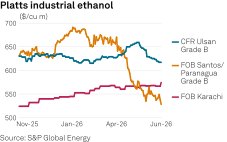
Platts, part of S&P Global Energy, assessed Asian fuel ethanol at $639/cubic meter June 15, up $1.67/cubic meter day over day.